What is the minimum viable multi-agent setup for AI video production?
Last updated July 27, 2026
The minimum viable multi-agent setup is one orchestrator plus three specialists: a creative producer agent holding script and context, a storyboard or casting agent locking visuals, and a DOP agent generating shots. Add a fourth — a continuity or director's assistant agent — once your film has multiple scenes or evolving characters. Below this, a single well-directed agent is faster.
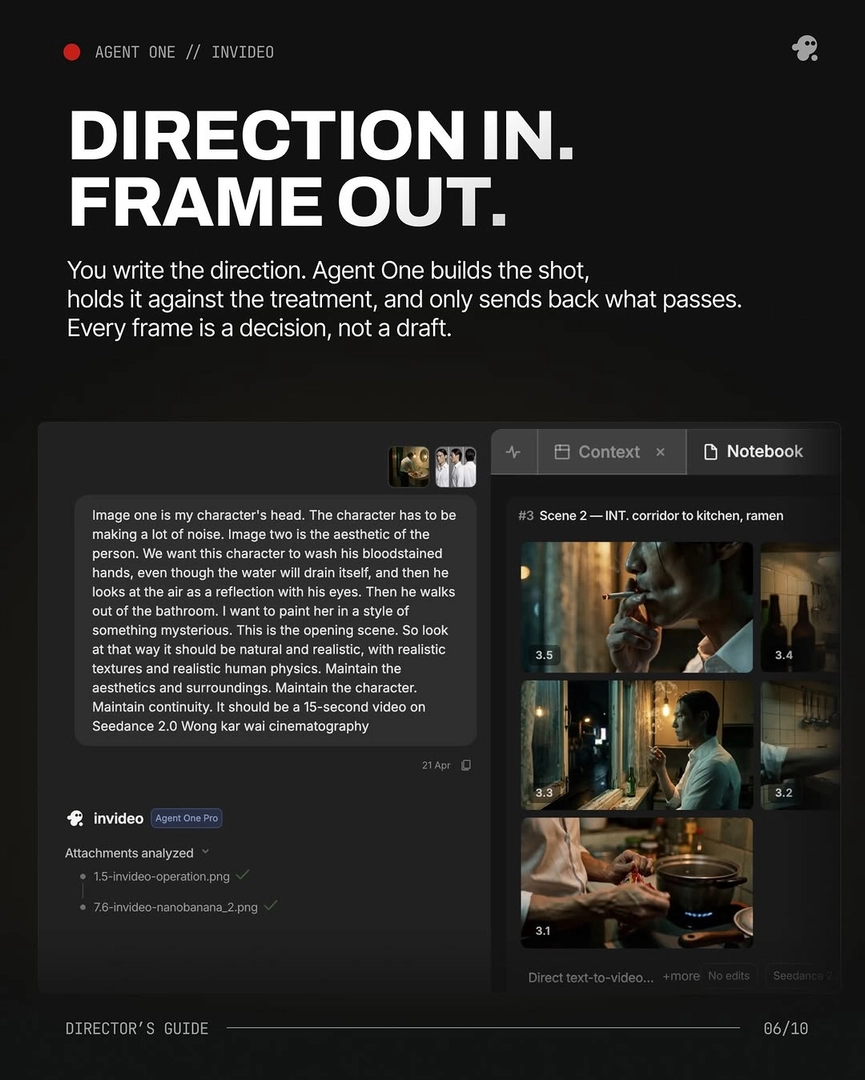
Start with one agent. If your job is a single scene, one character, one style, a single well-directed agent beats any crew — you save the coordination cost and there's no hand-off where context can drift. Go multi-agent only when the work splits into genuinely separable subtasks: script reasoning, casting/world images, shot generation, sequencing. invideo's agent is built for this — it's an agentic video creation tool with all the current video and image models (Veo, Kling, Seedance 2.0, Recraft, Nano Banana, GPT-Image-2) routed under one orchestration layer, so you spin up sub-agents inside one workspace instead of stitching tools yourself.
The MVP crew: 1 orchestrator + 3 specialists
Creative producer agent (the orchestrator). Initialize this first. Load the full script, shot breakdown, and character details into it — this is the agent that holds the vision of the entire film and grounds every specialist downstream. Without it, sub-agents drift apart. "To really set up the context for the agent, I normally start off with the creative producer agent. That's where I'll give the script, or the shot breakdown, along with the characters. That's the main agent that sort of holds the understanding and the vision of the entire film," says Hridaye, invideo's creative director.
A visuals-lock agent — storyboard or casting. Before any video generation, lock the look. A storyboard sub-agent visualizes each shot as a brief; a casting sub-agent generates character sheets (multi-angle turnarounds, close-ups) so characters stay consistent across every shot without LoRA fine-tuning. Pick whichever the film needs more — narrative films lean storyboard, character-driven shorts lean casting.
A DOP agent (shot generation). This is the agent you talk to on set: shot type, lens feel, lighting, blocking. It routes each shot to the right video model (Seedance 2.0 for reference-to-video continuity, Veo or Kling where they're stronger) and returns gens against the locked references.
That's the floor. One documented 2-minute brand promo ran the floor plus extras — 8 specialist agents across separate project pages — and shipped in 3 days for ~$1,500, against a 2-month, $100K–$500K traditional equivalent. A 70-second short ran a similar setup for ~$750 over 2 days. Different productions, same backbone.
Scale up by use case, not by default. Short-form social (one scene, one character): 1–2 agents is enough. Long-form or multi-scene narrative: add a fourth specialist — either a director's assistant agent to sequence the shot order and edit flow, or a second DOP per scene when each scene needs a different visual sensibility. Documented productions ran 6–8 agents simultaneously at peak; that's the ceiling for a 2–4 person team, not the starting point.
The structural risk to plan for. In a multi-agent pipeline, one bad output silently corrupts everything downstream — a wrong character sheet poisons every subsequent shot. Two defenses: lock character sheets and environment references BEFORE any video generation, and run a maker-checker pass where you send the rough cut back to the creative producer agent for an open-ended "what's working, what's not" review. That review step catches pacing and emotional-register errors human editors miss, and is the single most-skipped step in AI-directed work.
One agent vs many — the decision rule. Go multi-agent when (a) the workload has separable subtasks needing different models (image vs video vs sequencing), (b) you want parallel iteration — one sub-agent running character turnarounds while another generates shots, or (c) the film has enough scenes that one context window will drift. Stay single-agent when the job is scoped tight and sequential — extra agents add coordination overhead without payoff.
These are the agents to start with — what works depends on your film's shape and scene count.
Watch some of these to see what works for you:
To really set up the context for the agent, I normally start off with the creative producer agent. That's where I'll give the script, or the shot breakdown, along with the characters. That's the main agent that sort of holds the understanding and the vision of the entire film.
— Hridaye, invideo's creative director