Why do most AI video shots require multiple generation attempts?
Last updated July 27, 2026
Most AI video shots need multiple generation attempts because video models generate probabilistically — the same prompt returns a different result every run, so variance in character, motion, and framing is built in, not a malfunction. Documented productions average 3 generations per usable shot, and only ~25% of generated clips survive editorial selection.
An AI video model does not execute your prompt the way a crew executes a shot list — it samples from latent noise and produces a weighted guess at what your words describe. Run the identical prompt twice and you get two different interpretations: a character's face drifts, the camera moves differently, the motion resolves another way. Multiple attempts aren't error recovery; they are how the technology works.
Documented production numbers show the scale of this variance. One 3-minute animated episode required 164 generated clips, of which 41 made the final cut — a 25% selection rate — with an average of 3 generations per usable shot. A ~90-second horror short consumed roughly 400 video generations. Even locking a single character's visual identity took about 5 generations (~$9.78 per character). And usability is partial even within a kept clip: on average only 5 seconds of each 15-second clip was used, because a generation can nail the framing but miss the motion, or hold the character but break the lighting. As invideo's creative team put it after the episode wrapped: "Out of 164, 41 videos made the cut, and on average only 5 seconds of each 15-second clip was used. That's how 41 clips became a 3-minute episode."
Some shot types push the attempt count well above the average because they sit at the edge of what current models resolve reliably. Multi-character contact shots — bodies, ropes, props touching — break models faster than almost any other scenario. POV shots typically take multiple iterations and multiple prompting techniques. Over-the-shoulder shots are a documented weak point of Nano Banana that prompting alone cannot resolve. If your script leans on these, expect a higher generation count on those scenes specifically.
Context loss between attempts compounds the variance. Each generation starts fresh unless references are carried forward: legacy start-frame/end-frame methods give the model no context beyond the frames you upload, so character, location, and camera logic have to be re-guessed every run — which is exactly what produces drift across attempts. Methods that carry context forward, like Seedance 2.0 reference-to-video accepting character references, location references, and the prior clip, reduce that re-guessing; tools like the invideo agent do this automatically by holding your character sheets and style references in persistent context and attaching them to every generation.
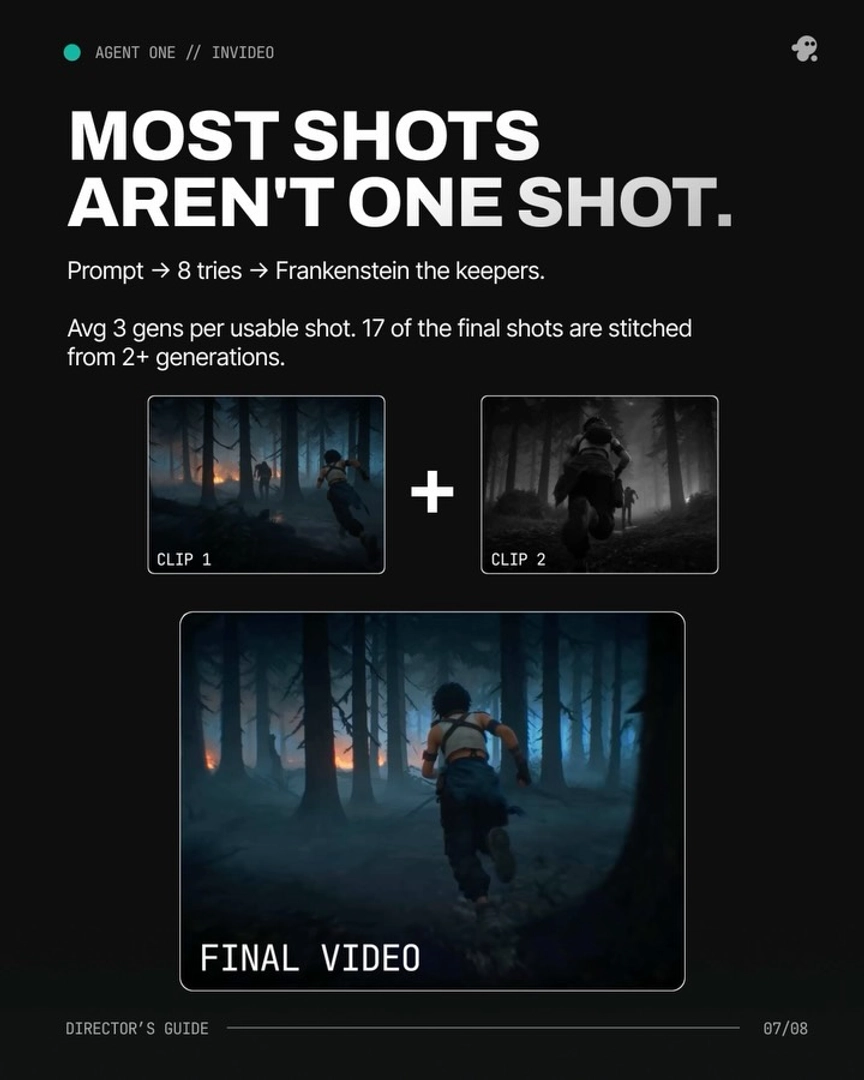
Beyond the why: experienced teams treat overgeneration as a deliberate budget line rather than waste — each 15-second clip typically yields 4–7 usable shot candidates, and when no single generation is fully usable, the strongest seconds from two or more runs get stitched into one Frankenstein shot (17 final shots in the documented episode were composites).
Watch some of these to see what works for you:
Out of 164, 41 videos made the cut, and on average only 5 seconds of each 15-second clip was used. That's how 41 clips became a 3-minute episode.
— invideo's creative team