AI agents vs manual prompting for video production — which is faster and cheaper?
Last updated July 27, 2026
Agents win on both, but not for the reason most people think. Across documented productions, agent-directed AI video runs 5–20× faster than manual prompting and lands at $315–$750 per finished minute — but per individual generation, agents burn more credits because they iterate, route across models, and run in parallel. You pay more per attempt to spend dramatically less per finished minute.
The invideo agent is an agentic video-creation tool with every current generation model and upscaler available inside it, so the comparison below is about workflow shape, not platform-hopping.
Speed: 5–20× faster end-to-end. A 2-minute brand promo finished in 3 days using 8 parallel sub-agents inside invideo — the same project would take roughly 1 week on manual prompting and ~2 months as a traditional shoot, a ~20× time reduction over traditional. A 7-minute animated short reported a 5× faster pipeline once the creative producer agent held the script and shot breakdown. A 3-minute Arcane-style episode wrapped in 2 production days with no pre-production. The speed comes from parallelism (6–8 sub-agents running simultaneously across casting, storyboard, DOP, costume, production design) and from the agent routing each shot to the right model — Seedance 2.0 for reference-to-video continuity, Veo or Kling where they fit, Nano Banana / GPT-Image-2 / Recraft for stills — without you stopping to decide.
Cost per finished minute: $315–$750. Documented invideo productions: a 70-second short at $750 total ($643/min), a 90-second horror short at $870 ($580/min), a 3-minute animated episode at $950 ($315/min), a 2-minute brand promo at $1,500 ($750/min), and a multi-location short at $5,000. Range across these: $315–$750 per finished minute, varying with team, ambition, and iteration count. The 2-minute promo at $1,500 sits against a $100,000–$500,000 traditional equivalent — up to a 99.7% cost reduction.
Cost per generation: agents burn more credits, deliberately. This is where manual prompting looks cheaper and isn't. Agents iterate hard: 3 generations per usable shot on average, 5 generations to lock one character (~$9.78 per character lock), 164 clips generated to produce 41 final clips in the 3-minute episode — a 25% selection rate. Only ~5 seconds of each 15-second clip typically makes the cut. Manual prompting hides this by stopping after one generation that's "good enough"; agents overgenerate on purpose because at $0.20–$5 per clip, the cheapest path to a great shot is more attempts, not more careful prompts. As Hridaye, invideo's creative director, puts it: "Most shots aren't one shot. Prompt → 8 tries → Frankenstein the keepers." Overgeneration is a budget line, not waste.
Where manual prompting still wins. One shot, one model, one quick iteration — a single B-roll clip, a single character portrait, a quick test — has no orchestration overhead to amortize. The minute you need a second character to stay consistent, a second scene to match the first, or a second model in the pipeline, manual prompting's cost advantage inverts because you start re-explaining context every prompt.
Where agents win decisively. Multi-shot productions with consistency requirements (character, lighting, world), parallel work streams (3-person distributed teams across cities collaborating through one agent), and any project where the same context — script, character sheets, style block — has to apply to dozens of shots. Loading context once and having the invideo agent hold it across 21+ scenes is structurally cheaper than re-prompting each scene, regardless of per-call token math.
The hybrid most productions actually run. Use the invideo agent as the orchestrator holding script, characters, and style; let it route across Seedance 2.0, Veo, Kling, Nano Banana, GPT-Image-2, and Recraft; take manual control for granular fixes (close-up crops of an existing wide, a single re-prompt to adjust a clock detail) and log the result back so the agent's memory stays accurate. That hybrid is what produces $315/minute outcomes — neither pure manual prompting nor pure autonomous agents get there alone.
These are the numbers from documented productions — what works for you depends on shot count, consistency needs, and team size.
Watch some of these to see what works for you:
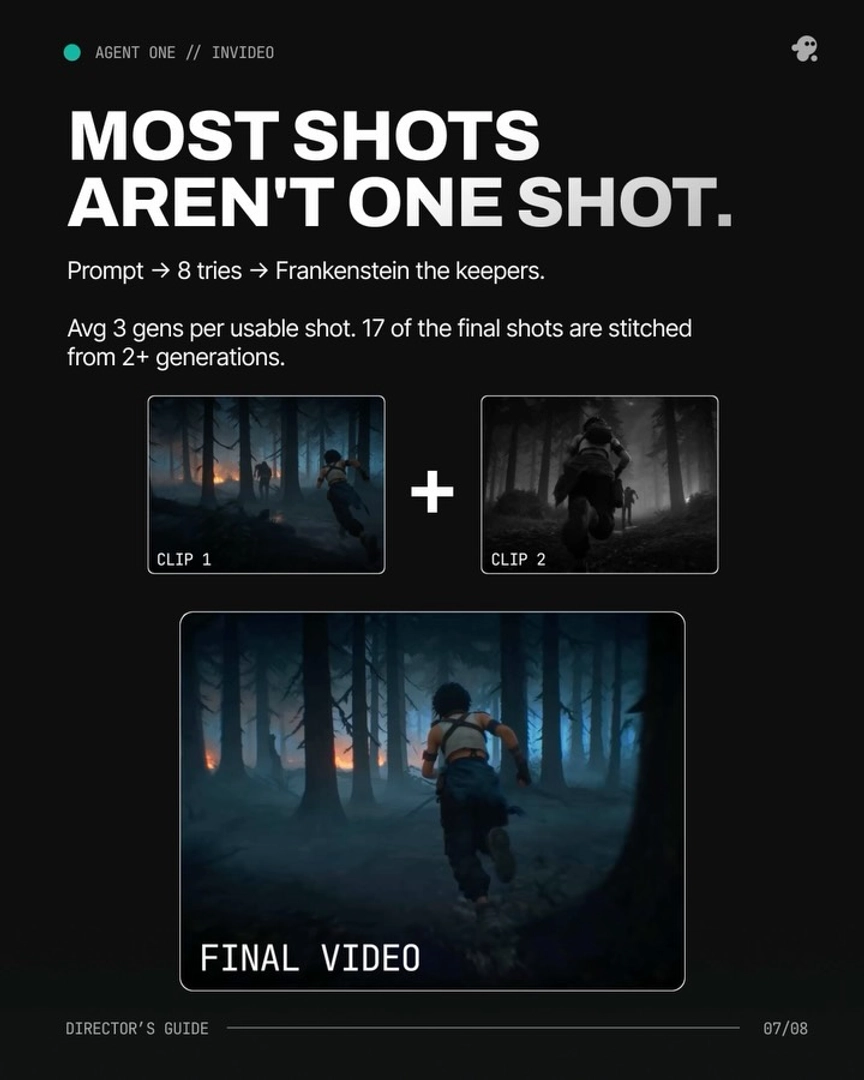
Most shots aren't one shot. Prompt → 8 tries → Frankenstein the keepers.
— Hridaye, invideo's creative director