Can a 2-person team produce a professional animated episode using AI tools?
Last updated July 27, 2026
Yes — a 2-person team can produce a professional animated episode using AI tools. One documented production made a 3-minute Arcane-style animated episode in 2 days for ~$950 ($315 per finished minute), with no pre-production, no LoRA, and two people splitting the roles of creative director and pipeline operator inside the invideo agent.
Split the work into two roles and run them in parallel. One person directs — script, style, shot choices, editorial selection. The other operates the pipeline — locking character sheets, running generations, organizing clips, prepping the edit. A documented 2-person production ran exactly this way: one team member locked character turnarounds while the other was already generating shots, and they finished a 3-minute episode in 2 days for ~$950 total.
invideo is an agentic video creation tool that holds every current video and image model (Runway, Veo, Kling, Seedance 2.0, Recraft, Nano Banana, GPT-Image-2) behind one agent that routes each shot to the right model — so a 2-person team doesn't have to manage multiple platforms, accounts, or handoffs.
What each person actually does
The director writes the script, loads it into a creative producer agent for full narrative context, locks the visual style once (style references, palette, mood), and makes editorial calls — which of the 4-7 usable candidates inside each 15-second generation goes into the cut. Hridaye, invideo's creative director, frames the shift directly: "The thing that made it possible wasn't prompting. It was directing. The invideo agent didn't feel like a tool — it felt like crew."
The pipeline operator runs the production: spins up sub-agents (a storyboard agent, a DOP agent per scene, a casting agent for character sheets), keeps the style block attached to every prompt, generates in chunks, and feeds approved clips into the edit. With the agent in always-ask mode, every generation gets shot-by-shot approval before credits burn.
The realistic cost and time range
Across five documented productions, the all-in spend ran $750–$5,000 and the timeline ran 2–5 days:
Production | Length | Team | Days | Cost |
|---|---|---|---|---|
Animated episode (Arcane style) | 3 min | 2 | 2 | $950 |
Short film (WKW style) | 70 sec | small | 2 | $750 |
Horror short | 90 sec | small | 2 | $870 |
Brand promo | 2 min | 1 | 3 | $1,500 |
Multi-location short | — | 4 | 4–5 | $5,000 |
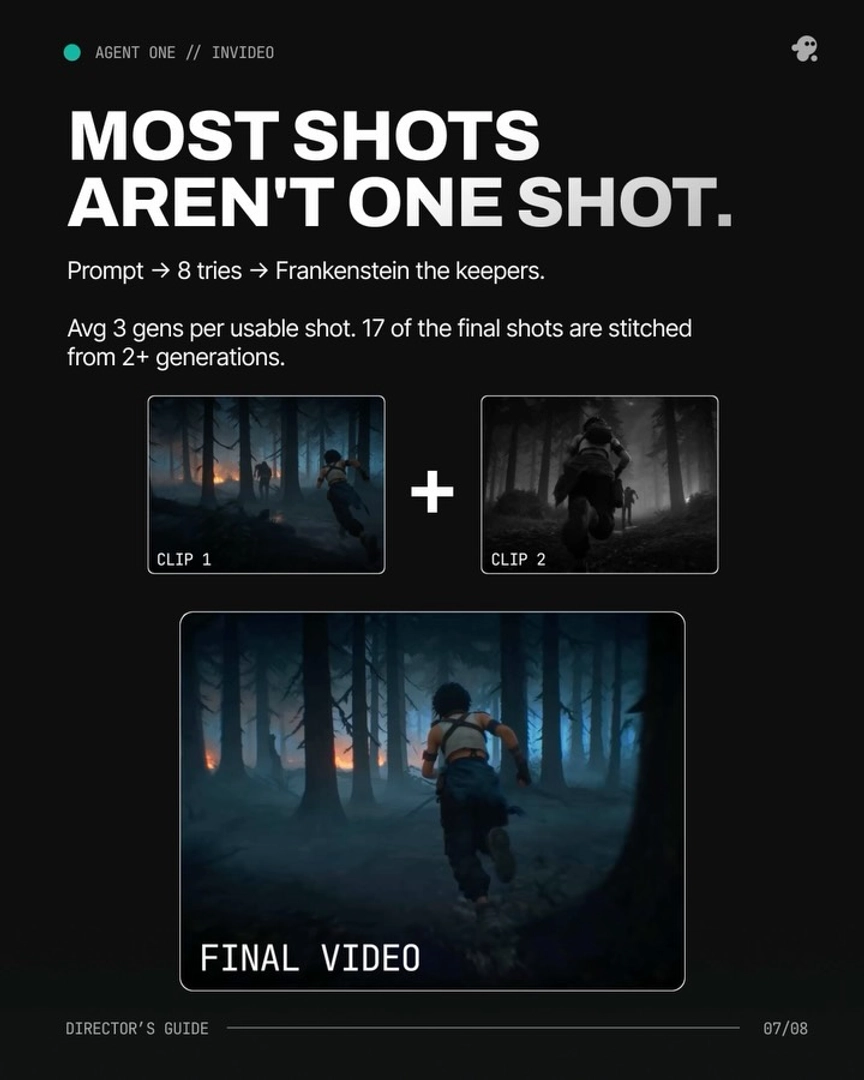
Per finished minute, that's $315–$750. The 2-person animated episode sat at the low end ($315/min) because the workflow was tight: 64 style-reference frames loaded once, ~5 generations to lock each character (~$9.78 per character), 164 Seedance 2.0 clips generated, 41 making the final cut (~25% selection rate), and an average 3 generations per usable shot.
Where consistency comes from with only 2 people
Lock character sheets and environment references BEFORE any video generation — 4 options per asset, pick the best, store in agent context. A documented 70-second 2-character film held the same person across every scene without LoRA, using only character sheets plus the agent's persistent context. Attach the locked style block to every single generation prompt — "every prompt after this started with it" is how the Arcane-style team described the discipline that kept 164 clips visually coherent.
The honest caveats
This produces professional-LOOKING animated episodic content, not Pixar-grade theatrical animation. Expect ~25% of generations to make the cut — overgeneration is a planned budget line, not waste. About 40%+ of final shots get composited from 2+ generations (stitching the best seconds from multiple runs into one shot). Human oversight is non-negotiable for story logic, character continuity, and the cut review pass — skipping the rough-cut review is the most common failure mode. The 2-person split works because each role has clear ownership; if both people try to direct AND operate, context fragments and credits get wasted.
The productions cited above are real examples — different teams legitimately produce at different costs depending on scope, length, and complexity.
Watch some of these to see what works for you:
The thing that made it possible wasn't prompting. It was directing. Agent One didn't feel like a tool — it felt like crew.
— Hridaye, invideo's creative director