Yes — the invideo agent can run autonomously overnight, and creators use this as a real production tactic: queue character iterations, costume variations, or batch generations before bed and wake up to options. The catch: lock context tightly before you leave, gate final approvals to morning, and treat overnight runs as exploration passes, not unsupervised final-cut delivery.
Set it up so the agent has everything it needs to keep working without you. invideo is an agentic video creation platform where you can deploy multiple named sub-agents (a creative producer agent, a casting agent, a DOP agent, an upscale artist) that hold context across long sessions — which is what makes overnight runs viable in the first place.
What to queue overnight (high-value, low-risk tasks)
Give the agent jobs where iteration volume is the point and no single output is load-bearing: character costume and look variations, multi-angle character sheet generation, world-building image grids, batch upscaling of approved clips, and exploratory shot variations on locked references. One creator described leaving the agent generating seven costume variations during a coffee break — overnight scales that same pattern up. As Hridaye, invideo's creative director, put it: "AI agents can continue production work autonomously overnight, functioning as a non-stop fourth team member."
Lock context before you walk away
The agent only stays useful overnight if it has full context loaded: the script, character sheets, world references, style block, and any explicit "what to take and what to leave out" instructions. Creators routinely run 6–8 specialist sub-agents in parallel across separate project pages for exactly this reason — each one has its own scoped context that won't drift while you sleep. One documented 2-minute brand promo ran 8 specialist agents simultaneously across separate pages; a 3-minute animated episode ran with a 2-person team using parallel agents to compress a multi-week pipeline into 2 days.
Gate final approvals to the morning
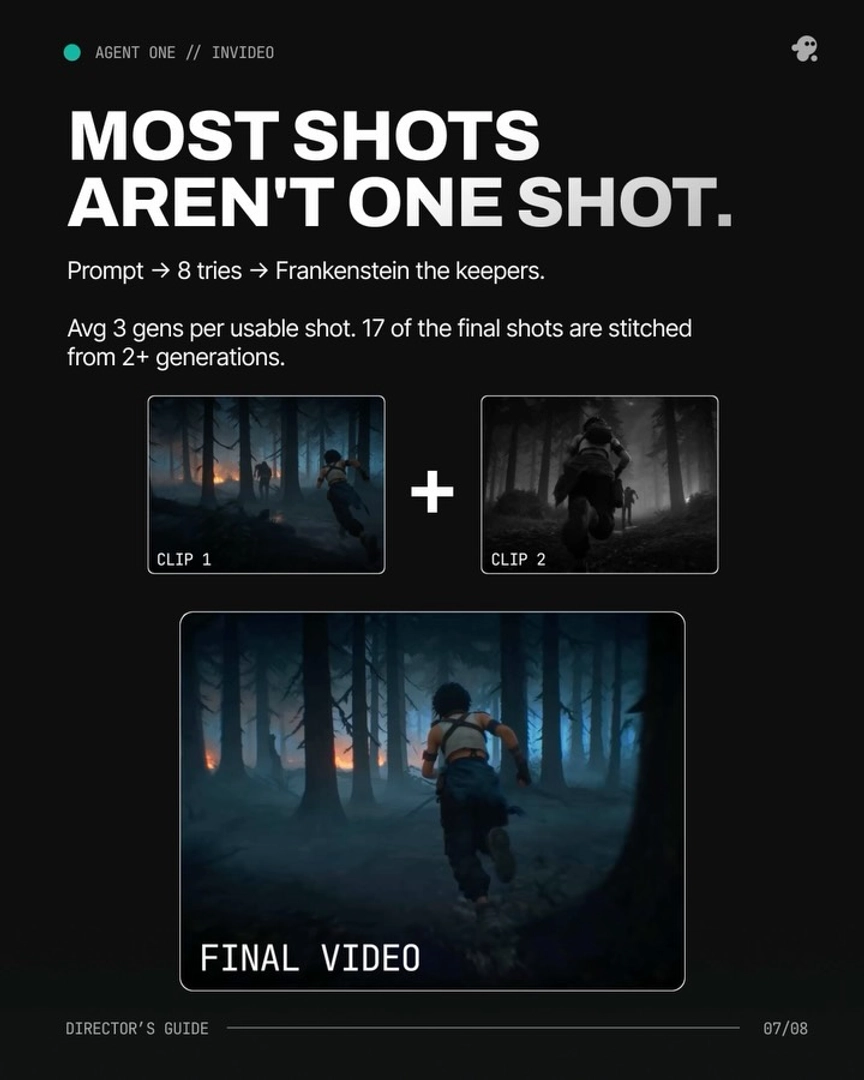
Switch the agent to a shot-by-shot approval mode for anything that spends meaningful credits or commits to final-cut output. Overnight you want the agent exploring and queuing options — not auto-approving its own work. Across documented productions, only about 25% of generated clips make the final cut (41 of 164 in one episode; ~3 generations per usable shot on average), so overnight runs are best understood as filling the top of the funnel for you to review at 9am.
Build in guardrails
A few practical ones creators use: cap the credit budget per sub-agent so a runaway loop can't drain a project; queue jobs in batches with checkpoints rather than one monolithic instruction; keep a status-summary prompt ready for the morning ("what's approved, what's pending, what needs regeneration") to restore orientation fast; and never push final delivery through an overnight run — the maker-checker review pass on a rough cut is where pacing and emotional-stage errors get caught, and that step needs you awake.
The honest limit
Overnight autonomy works for generation, iteration, and exploration. It does not replace directorial judgment on selection, editing, or final approval — and creators are explicit that the skill making this work is directing, not prompting. Treat overnight runs as your queued night shift: the morning is when you direct.
Watch some of these to see what works for you:
AI agents can continue production work autonomously overnight, functioning as a non-stop fourth team member.
— Hridaye, invideo's creative director