How do you save credits when generating AI videos — practical tips to avoid burning your budget?
Last updated July 27, 2026
Save credits by locking inputs before you spend them: generate cheap images first, lock character sheets and world references in 4-option grids, then generate video in small chunks with shot-by-shot approval. Plan for ~3 generations per usable shot and ~25% clip yield — overgeneration is a budget line, not waste.
Start every session image-first. Image generations cost a fraction of video generations, so use them to resolve every decision that would otherwise be paid for in video credits — character look, costume, world, palette, composition. Generate grids of 3-4 options per asset instead of one-offs, pick the winner, and lock it. As Hridaye, invideo's creative director, puts it: "Rather than generating one, one, one, one, one images to generate grids. Image generation doesn't cost much, especially in invideo. Use that to your advantage."
Lock character sheets and world references BEFORE any video generation. One documented short film spent 5 generations to lock each character (~$9.78 per character) and 11 total reference images for 4 characters and 1 prop — that upfront image spend is what prevents re-rolling expensive video clips later when a face drifts. Generate 4 options per asset, pick one, and freeze it as the reference every downstream prompt attaches to.
Generate video in short chunks with approval gates, not long open-ended runs. Break the script into ~15-second segments and run the invideo agent in Always Ask mode so you approve each prompt and attached references before credits move. Hridaye: "You write the direction. Agent One builds the shot, holds it against the treatment, and only sends back what passes. Every frame is a decision, not a draft." Skip the approval step and you pay for misses you would have caught reading the prompt.
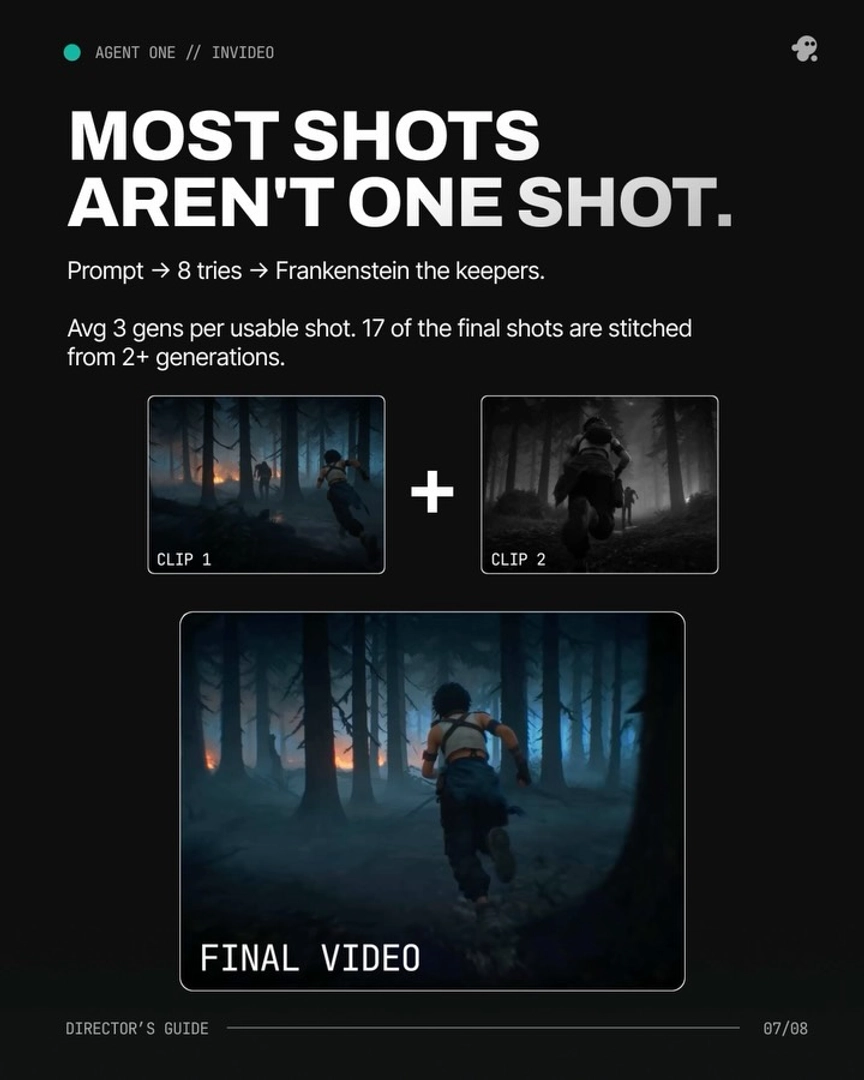
Budget for iteration — don't pretend you won't need it. Across a documented 3-minute animated episode: 164 clips generated, 41 made the cut (~25% yield), average 3 generations per usable shot, average 5 seconds used from each 15-second clip, and 17 of the final shots were stitched from 2+ generations (Frankenstein shot assembly — using the best seconds from multiple takes). Plan the credit budget against those ratios, not against a fantasy of one-shot generations.
Route each shot to the right model instead of defaulting to your most expensive one. invideo is an agentic video creation tool with every current generation model and upscaler inside it, so the invideo agent routes each shot to the model that fits — Seedance 2.0 reference-to-video where character/location context must carry, Kling or Veo where the strength matches the shot, Runway where appropriate. Reserve your premium model for hero shots; let a lighter model handle B-roll, establishing plates, and inserts. Same logic on images: Recraft for photoreal faces with real skin texture, Nano Banana / GPT-Image-2 for character sheets and grids.
Validate the script and shot list before you generate. Load the full script into the invideo agent and ask it to flag model limitations and scenes likely to fail — one documented production had the agent flag an 18-cuts-in-15-seconds scene as impractical and recommend splitting it, saving the credits a doomed generation pass would have burned. Same loop after the rough cut: send it back to the agent for a maker-checker pass on pacing and continuity before you re-generate anything.
Track credits-per-usable-second, not credits-per-generation. Documented all-in costs across five productions: $750 (70-sec short, 3,000 credits), $870 (~90-sec horror short, 4,100 credits, ~400 video gens), $950 (3-min animated episode), $1,500 (2-min brand promo, 6,000–6,500 credits), $5,000 (multi-day short, 20,000 credits) — that's $315–$750 per finished minute depending on team and ambition. Knowing your own credits-per-finished-second number after the first project is what makes the next one cheaper.
A few smaller habits that compound: keep references batched and labeled (tell the agent what to take AND what to leave out — wrong attachments cause wrong outputs you then pay to redo); use a status-summary prompt mid-project to see what's approved vs pending before regenerating; for tiny crop/close-up variations, take manual control of the image prompter instead of running a full agent loop, then log the result back so the agent's memory stays accurate.
These are the levers that move the credit bill — what matters most depends on the project's shape and which stage is leaking budget.
Watch some of these to see what works for you:
Rather than generating one, one, one, one, one images to generate grids. Image generation doesn't cost much, especially in invideo. Use that to your advantage.
— Hridaye, invideo's creative director