How do you stitch multiple AI video generations together into one seamless shot?
Last updated July 27, 2026
Stitching AI video generations into one seamless shot comes down to three methods:
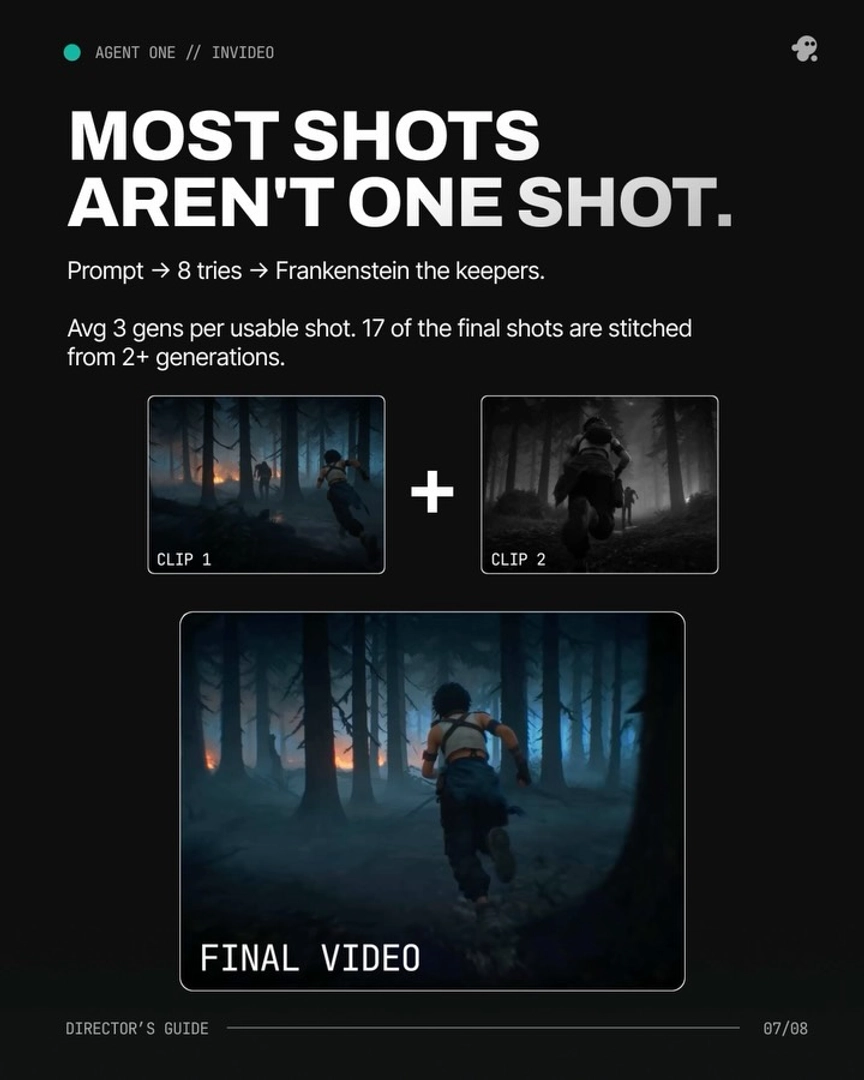
Frankenstein shot assembly — cut the best seconds from multiple generations into one composite shot
Reference-to-video chaining — feed each clip's ending into the next generation
Native multi-shot generation — have the model generate connected shots in one pass In one documented production, 17 of the final shots were stitched from 2 or more generations.
Frankenstein shot assembly — cut the best seconds from multiple generations. Generate the same prompt several times, then treat each output as raw coverage, not a finished shot: a single 15-second clip typically contains 4–7 usable shot candidates, so scan every generation for its strongest seconds rather than judging it whole. Pull the keepers into an NLE — Premiere Pro or DaVinci Resolve — and cut them into one composite shot, hiding joins on motion, on a whip, or on an action beat. invideo is an agentic video creation tool with all the current video models available, so you can run the repeated generations and selection inside one project; one documented 3-minute animated episode produced this way averaged 3 generations per usable shot, used roughly 5 seconds of each 15-second clip, and kept 41 of 164 generated clips — a 25% selection rate, which makes overgeneration a planned budget line rather than waste.
Reference-to-video chaining — when the shot must be physically continuous. For a true one-take, don't cut between generations at all: clip the end of each generated segment and re-upload it to the invideo agent, which attaches it to Seedance 2.0 reference-to-video along with your character sheets and location references to generate the next segment. Because the model ingests the entire prior video — not just a frame — it carries camera movement, framing, and atmosphere across the boundary, which is why this outperforms older start-frame/end-frame methods and the extend feature: extend can't accept character or location references, reference-to-video accepts both. If your character's appearance evolves across the take, make a separate character sheet for each beat so consistency holds segment to segment.
Native multi-shot generation — avoid manual stitching where the model can do it. When you can plan the continuity before generating, route the sequence to a model that outputs connected shots natively: Kling 3.0 generates multi-shot sequences in a single pass, while Seedance 2.0 is the stronger pick for reference-driven continuity across separately generated segments. All of these models run inside invideo, so the invideo agent can route each sequence to whichever approach fits — native multi-shot for planned cuts, chaining for continuous takes, Frankenstein assembly when you're rescuing the best moments from multiple attempts.
Match the look across the joined clips. Clips from different generations rarely share an identical finish, so run one consistency pass after assembly: a small amount of blur, added grain, and a matched color grade across all segments removes the texture shifts that make a cut point visible.
These are some of the ways to problem-solve this — what works depends on your shot.
Watch some of these to see what works for you:
Once that's done, you clip it, and now you re-upload that to Agent 1. And Agent 1 then attaches that to Seed Dance reference to video, and continues the next whole sequence in one seamless continuous take.
— invideo's creative team