How does 'Always Ask' approval mode in an AI video agent give directors shot-by-shot creative control?
Last updated July 27, 2026
Always Ask mode makes the invideo agent pause before every generation, show you the prompt and references it's about to send, and wait for your explicit approval before any credits are spent. You approve, revise the prompt, swap references, or kill the shot — so every clip in your film is a directorial decision, not a draft the agent shipped on its own.
Use it as a per-shot approval gate on the render call. The invideo agent is an agentic video tool that routes each shot to the right model (Seedance 2.0, Kling, Veo, etc.) and holds your project context across scenes; flipping it to Always Ask means the generate/render step never auto-executes — the cheap, reversible work (reading the script, picking references, drafting a prompt) runs freely, but the expensive, credit-burning work stops at a confirmation step you control. This mirrors the read-vs-write gating pattern used in agent frameworks like OpenAI's Agents SDK (needs_approval: always) and CodeAct (approval_mode='always_require'), applied specifically to the video generation tool call.
What the agent shows you at the gate. Before each 15-second clip generation, you see the assembled prompt (camera, lens, lighting, palette, composition, atmosphere, mood, negative prompt), the character sheet and style references the agent attached, the target model and shot length, and the credit cost. You then do one of four things: approve as-is, edit the prompt and re-submit, swap or add references (a different character sheet panel, a phone-shot mock for the camera move, a new location plate), or skip the shot entirely. "You write the direction. The invideo agent builds the shot, holds it against the treatment, and only sends back what passes. Every frame is a decision, not a draft," says Hridaye, invideo's creative director.
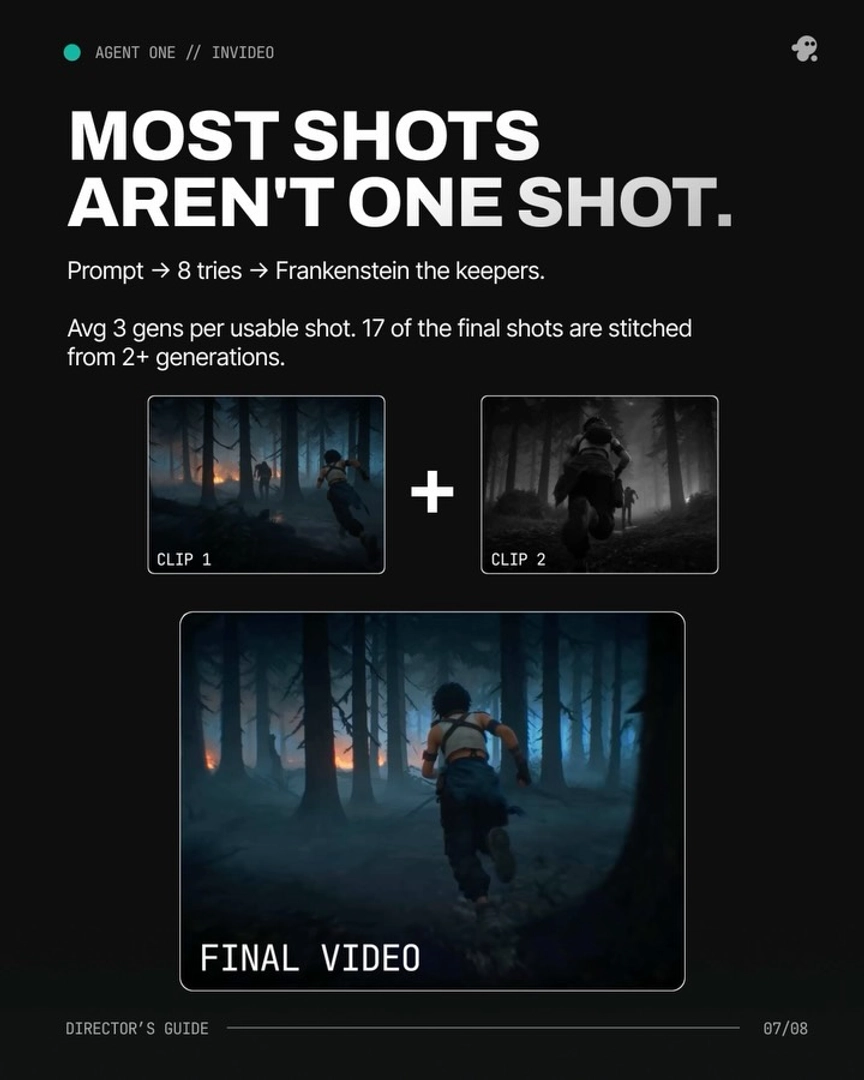
Shot-by-shot control across a real production. On a 3-minute animated episode, the team generated 164 clips in 15-second chunks and only 41 made the final cut — a 25% selection rate, with about 5 usable seconds per clip. Without Always Ask, that 75% miss rate would have burned credits silently; with it, the director catches drift at the prompt stage (wrong palette, missing negative constraint, wrong reference attached) before the render runs. Average cost to lock a single character ran ~$9.78 across 5 approved generations; average 3 generations per usable shot. Across documented productions, finished-minute costs landed at $315–$750 — a band that's only achievable when a human is approving each spend.
Where the gate catches the silent failures. Style drift is the main one — auto-run mode lets the agent quietly relax your locked style block over a long sequence; Always Ask surfaces the prompt every time so you catch a missing "hand-painted brushstroke texture, not photorealistic" line before it ships. It also catches wrong references attached (a stray image breaking clock continuity is a documented failure mode), wrong model routing for a shot type the model is weak at (OTS shots on certain image models, multi-character contact shots on video models), and prompt assembly drift across a 9-element template.
When to relax the gate. Always Ask is the default for hero shots, character-locking passes, and any sequence where consistency matters across many clips. For exploratory work — generating 3 grid options of a world, running 5 variations of an abstract sequence, or running the same prompt on two image models in parallel for casting — switch to a lighter mode so the agent can fan out without stopping. A practical pattern: Always Ask on the render/video tool, auto-run on read-only tools (script analysis, reference scouting, shot breakdown drafting) and on cheap image grids.
How it fits a multi-agent setup. When you've spun up a creative producer agent, a storyboard agent, and a DOP agent per scene, Always Ask sits on each agent's generation step independently — your DOP agent for Scene 4 can be paused on a shot while your DOP agent for Scene 7 keeps proposing prompts for your review. This is how a 2-person team approved 164 generations across a 2-day sprint without losing track of what was locked vs. pending.
These are some of the ways Always Ask gives you control — what you gate and what you let run depends on the shot.
Watch some of these to see what works for you:
You write the direction. Agent One builds the shot, holds it against the treatment, and only sends back what passes. Every frame is a decision, not a draft.
— Hridaye, invideo's creative director