How long should AI video clips be when generating a short film?
Last updated July 27, 2026
Generate in 15-second clips and plan to keep about 5 seconds of each. In one documented 3-minute animated episode, 164 fifteen-second Seedance 2.0 generations produced 41 used clips, averaging 5 usable seconds per clip. Treat each generation as a candidate pool of shot options, not one finished shot.
Set your generation unit at 15 seconds, because each 15-second clip typically contains 4–7 usable shot candidates — you select the best seconds, you don't use the whole clip. invideo is an agentic video creation platform with all the current video models available, and in a documented production the invideo agent generated Seedance 2.0 clips in 15-second chunks in the film's aspect ratio, with the director pulling an average of 5 seconds from each clip into the cut. That math is why the 15-second unit works: it's long enough to give you selection options, short enough to keep iteration cheap.
Budget your generation count around yield, not around runtime. Across that same 3-minute episode, only 41 of 164 generated clips made the final cut — a ~25% selection rate — and usable shots took an average of 3 generations each, so overgeneration is a deliberate budget line, not waste. Expect to composite too: 17 of the final shots were Frankenstein shots, stitched from the best seconds of 2 or more generations of the same prompt. Run the invideo agent in Always Ask mode so you approve each 15-second generation and its attached references before credits are spent.
Match your script's editorial density to the clip unit before you generate. One production's densest sequence packed 18 cuts into 15 seconds, and the invideo agent flagged the model limitation and recommended splitting the scene in two rather than burning credits on an unachievable generation — the split version cut sharper than the original script. As a rule, if a scene demands more cuts than a single 15-second clip can carry, divide it into multiple clips at the script stage.
For shots that need to run longer than one generation — continuous takes, long camera moves — chain clips instead of requesting one long generation. Clip the end of each generated segment, re-upload it to the invideo agent, and it feeds the full clip into Seedance 2.0 reference-to-video alongside your character and location references to continue the next segment seamlessly; because the model reads the end of the whole video, camera movement and stitching carry across segment boundaries in a way start-frame/end-frame or extend methods can't, since those accept no character or location references. Longer single generations also accumulate consistency drift, which is the structural reason short chunks remain the production unit across tools.
Model choice shifts the calculus slightly: Kling 3.0 generates multi-shot sequences natively, and multi-shot capability means you can get a 15-second sequence from a single storyboard frame — fewer storyboard frames, fewer credits — while Seedance 2.0 reference-to-video carries character and location context across chained clips. All of these models run inside invideo, so the invideo agent can route each shot to whichever model the length and continuity demands.
Watch some of these to see what works for you:
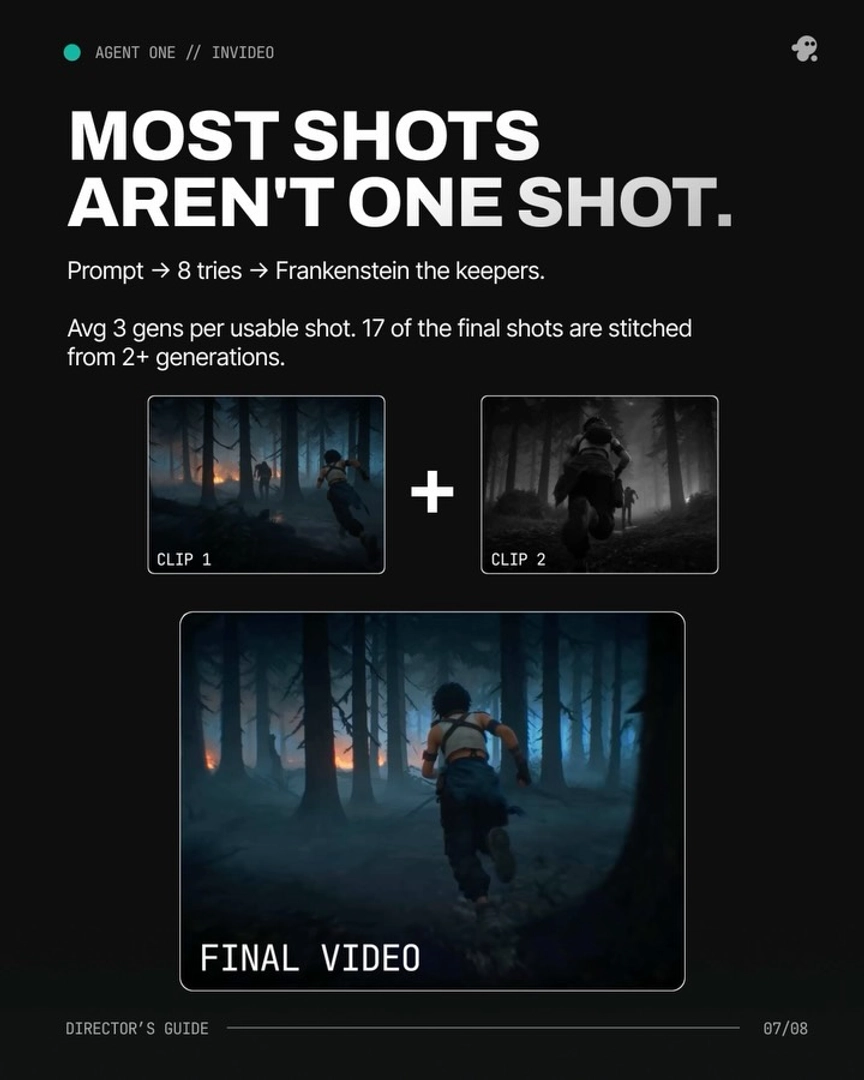
Out of 164, 41 videos made the cut, and on average only 5 seconds of each 15-second clip was used. That's how 41 clips became a 3-minute episode.
— invideo's creative team, documenting a 2-person, 2-day animated episode production