How much cheaper is AI film production compared to traditional filmmaking?
Last updated July 27, 2026
AI film production runs roughly 60–99% cheaper than traditional, depending on the format. Documented invideo productions land between $750 and $5,000 all-in — a 2-minute brand film cost ~$1,500 versus a $100,000–$500,000 traditional equivalent (up to 99.7% cheaper), and short narrative films cost $315–$750 per finished minute versus thousands traditionally.
The cleanest way to read the gap is per project type, because savings scale with what you'd otherwise spend on crew, location, and reshoots.
Brand films and commercials — the biggest gap. A 2-minute promo produced inside invideo cost $1,500 (6,000–6,500 credits) across 3 days with one director running 8 specialist sub-agents in parallel. The same spot shot traditionally runs $100,000–$500,000 — a reduction of up to 99.7%, and roughly 20x faster (3 days vs ~2 months). Manual prompting without an agent would still take at least a week for the same output. As Hridaye, invideo's creative director, puts it: "That comes to around about $1,500, which if you really think about it, is not that much in comparison to what you would spend if you had to make this in the traditional shooting way — because an ad like this would cost you anywhere from $100,000 to $500,000."
Short narrative films — $315 to $750 per finished minute. Across four documented productions, per-minute costs cluster tightly: a 3-minute animated episode in a hand-painted style hit $315/min ($950 total, 2 people, 2 days, 164 generated clips, 41 in final cut), a 90-second horror short hit ~$580/min ($870, 400 video generations, 4,100 credits), a 70-second narrative short hit ~$643/min ($750, 3,000 credits, 2 days), and a 2-minute brand film hit $750/min. Traditional short-film equivalents — even modest ones — run into the tens of thousands once you add crew, location, and post.
Larger productions — still a fraction of traditional. A more ambitious AI short film with international locations, VFX, and a long-take sequence cost $5,000 total (20,000 credits) across 4 active days with a 4-person team. That same brief shot traditionally would carry a six-figure budget at minimum.
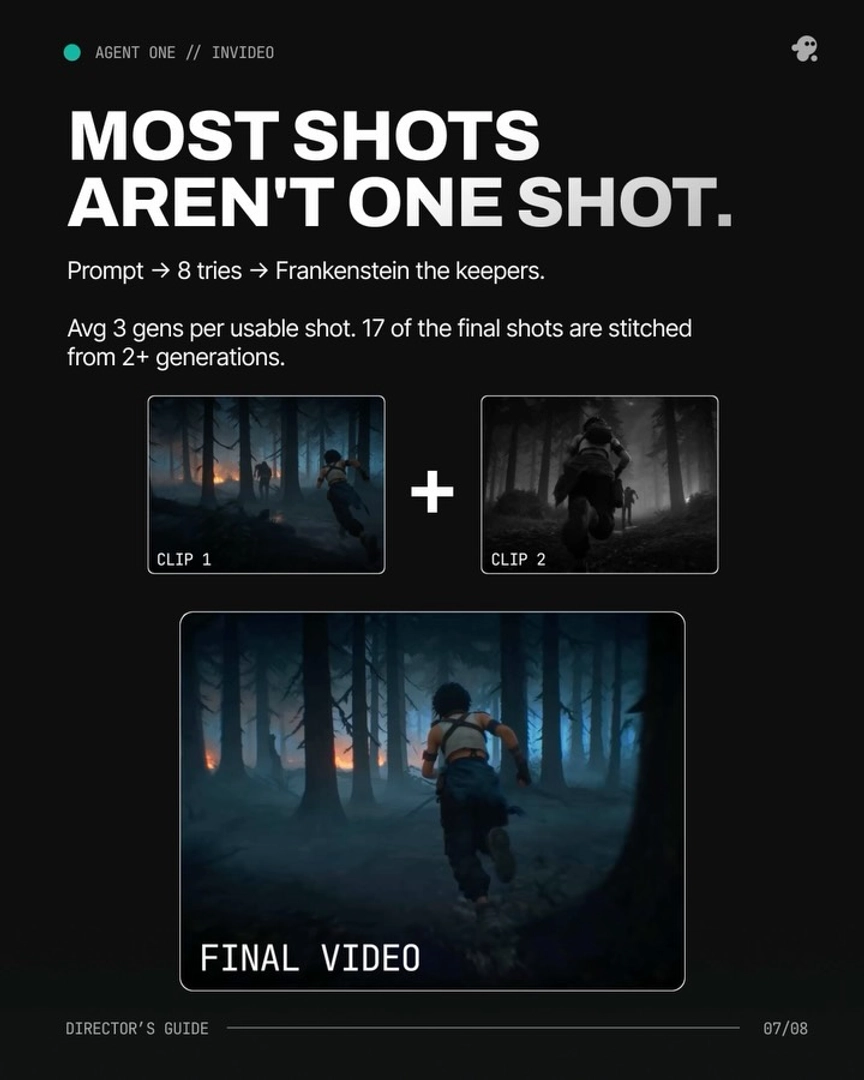
Where the savings actually come from. Three sources, in order of impact: (1) no physical production — zero crew day rates, location fees, equipment rental, or travel; (2) parallel iteration instead of reshoots — running 6–8 sub-agents simultaneously inside invideo compresses what would be sequential pre-pro, shoot, and pickup days into a single sprint; (3) editorial overgeneration is cheap — only 25% of generated clips made the final cut in one production, and ~3 generations were needed per usable shot, but at credit-level pricing that volume is a line item, not a budget blowout. Locking one character cost ~$9.78 across 5 generations.
Hidden costs to budget for honestly. Credits scale with iteration: complex shots (POV, multi-character contact, hallucination sequences) burn more attempts. Plan ~3 generations per usable shot and ~5 generations to lock each character. A treatment-style brief upfront reduces this — agents that hold project context across shots cut re-prompting and re-rolls significantly.
Hybrid strategy where it makes sense. For very high-end hero content where a real performance or signature location is non-negotiable, traditional still wins on those specific shots. AI dominates for variants, A/B versions, social cutdowns, animatics, pre-vis, and full short-form narrative or branded work — the categories where the 60–99% savings are real and repeatable.
These are the documented spreads — your actual number depends on length, shot complexity, and how tight your brief is before generation starts.
Watch some of these to see what works for you:
That comes to around about $1,500, which if you really think about it, is not that much in comparison to what you would spend if you had to make this in the traditional shooting way — because an ad like this would cost you anywhere from $100,000 to $500,000.
— Hridaye, invideo's creative director