How much faster is AI filmmaking compared to traditional filmmaking?
Last updated July 27, 2026
AI filmmaking runs roughly 5–20× faster than traditional production: a 2-minute brand film took 3 days on the invideo agent versus ~2 months for a traditional shoot, and a 3-minute animated episode finished in 2 days with no pre-production. Concept-to-delivery collapses from weeks or months into 2–5 days for most short-form work.
The invideo agent is an agentic video tool that holds your script, references, and direction across every shot and routes generations to models like Seedance 2.0, Veo, and Kling — so the speed gains come from compressing the whole pipeline into one conversation, not from any single trick.
Pre-production: weeks → 1 day. A traditional shoot spends weeks on scripting, storyboarding, casting, location scouting, and costume. On the invideo agent, a creative producer agent loads the full script once, a storyboard agent visualizes shots, and a casting agent generates character sheets in parallel — one documented production locked cast, costumes, look and feel, and world images in a single day with 3 people plus the agent. Five generations at roughly $9.78 lock a character; four options per asset (character sheet, environment) are produced and selected before any video begins. No pre-production at all was needed for the 3-minute animated episode.
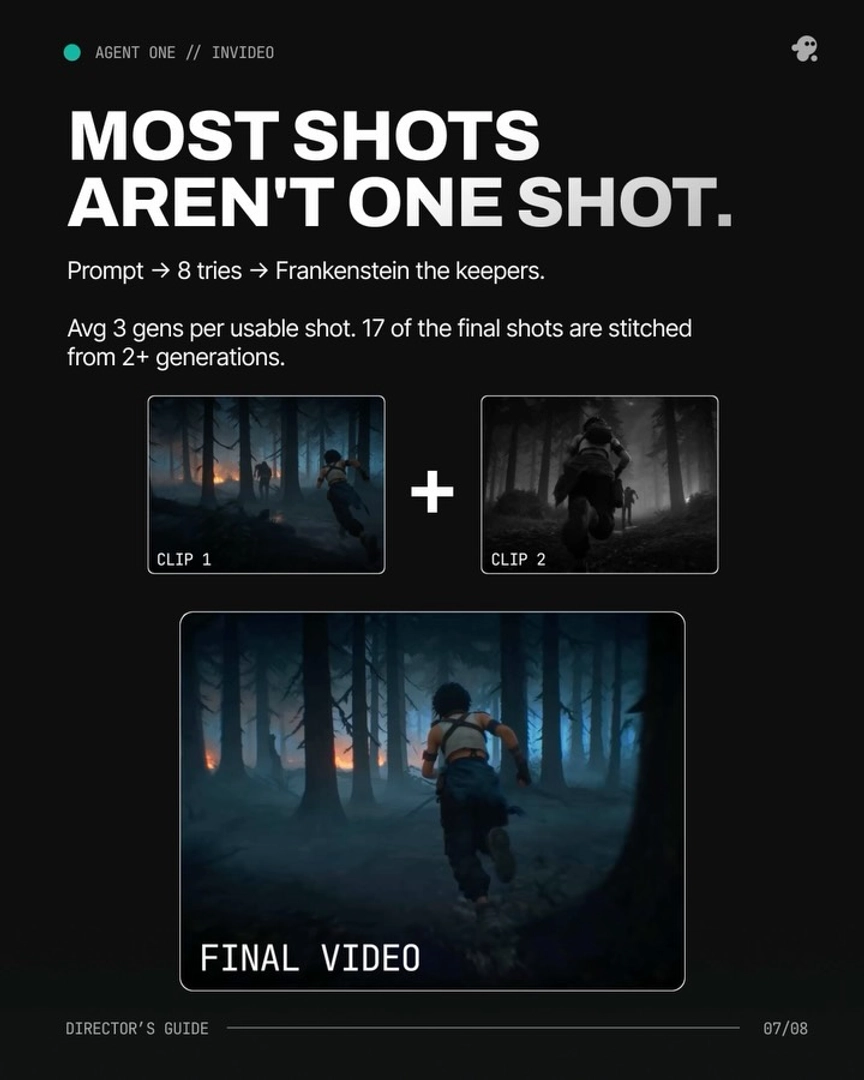
Production: months of scheduling → hours of generation. Traditional production needs crew calls, day rates, location windows, and weather. AI generation runs continuously — overnight if you want — and 8 specialist sub-agents can run in parallel across separate project pages. Documented yields: ~3 generations per usable shot, 164 clips generated for one 3-minute episode (41 made the cut), ~400 video generations for a 90-second horror short. A complex top-down shot the team had been fighting manually landed on the first try once it was routed through the agent.
Post-production: days → near real-time. Edits, color, upscale, and revisions that take days in a traditional cut compress into a maker-checker pass with the invideo agent reviewing the rough cut for pacing, SFX, and emotional register against the loaded style document. A dedicated upscale sub-agent batches finishing without manual intervention.
The documented speedups, by production:
Production | Length | Days | Traditional equivalent | Speedup |
|---|---|---|---|---|
Brand promo | 2 min | 3 days | ~2 months | ~20× |
Brand promo (vs manual prompting) | 2 min | 3 days | ~1 week | ~2.3× |
Animated episode | 3 min | 2 days | weeks of animation | — |
Wong Kar-wai short | 70 sec | 2 days | — | — |
Horror short | 90 sec | 2 days | — | — |
Animated short | 7 min | — | — | 5× pipeline |
Across six documented productions, finished short-form lands in 2–5 days with teams of 1–4 people. "Tips and tricks of using AI agents that'll make your production pipeline 5x faster and get rid of all the groundwork," as Hridaye, invideo's creative director, frames the headline gain.
Where the speedup is biggest — and where it isn't. AI wins decisively on high-volume, iterative, social and ad content where you want options, variations, and fast turnarounds — image generation is cheap enough to run 3-grid options per round, and a 2-minute promo that would cost $100K–$500K traditionally landed at $1,500. Traditional workflows still hold their own on high-craft live-action narrative where on-set control, performance direction, and production maturity matter more than turnaround. For most business, social, ad, and short-form narrative work, the 5–20× speed advantage decides it.
Watch some of these to see what works for you:
tips and tricks of using AI agents that'll make your production pipeline 5x faster and get rid of all the groundwork
— Hridaye, invideo's creative director