Seedance 2.0 vs Kling 3.0 vs Runway Gen-4: which is best for consistent characters across scenes?
Last updated July 27, 2026
For character consistency across scenes, Seedance 2.0 leads — its reference-to-video carries character, location and camera context across clips, and one documented 3-minute episode locked two characters across 41 final shots with no LoRA. Kling 3.0 is the strongest single-generation multi-shot option. Runway Gen-4 is best when you need fast iteration and clean editing of an already-locked character.
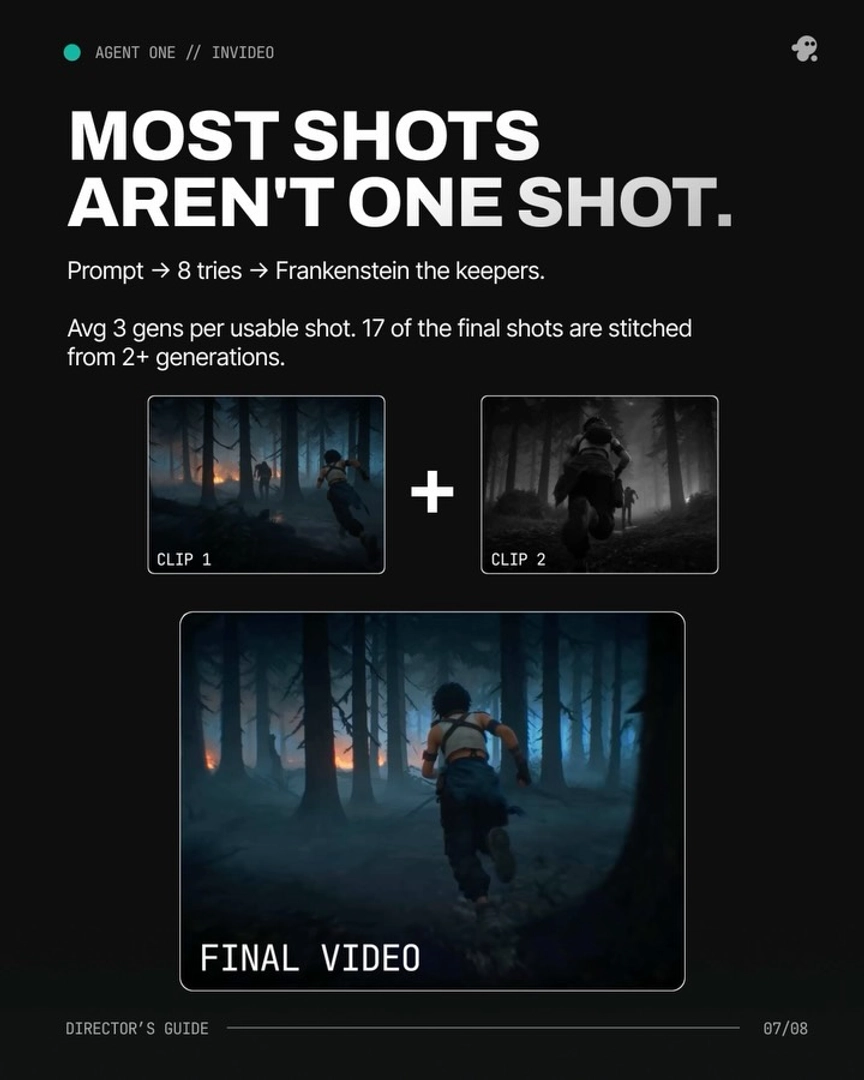
Use Seedance 2.0 as your character spine. It accepts character sheets plus a prior clip as reference, then reuses that identity, lighting and camera grammar in the next segment — which is why it holds appearance across long sequences without fine-tuning. In one documented 2-person production, ~5 generations were enough to lock a single character (~$9.78 per character lock), and the same two leads stayed consistent across 164 generated clips and 41 final-cut shots — averaging 3 generations per usable shot. Inside the invideo agent, you reupload the tail of each clip and it attaches it to Seedance 2.0 reference-to-video alongside the locked character sheet, so identity carries forward instead of resetting.
Reach for Kling 3.0 when a single scene needs several connected shots from one generation — it's the strongest of the three at multi-shot output from one reference set, useful for short coverage bursts where you want the cut already baked in. Treat it as a scene-level tool, not a long-form identity engine: across many scenes, lock the character in Seedance 2.0 first, then use Kling 3.0 selectively where its multi-shot framing earns its keep.
Reach for Runway Gen-4 when the character is already locked and you want fast, controllable iteration — it's the most editing-friendly of the three for tightening framing, swapping coverage, or generating brand-style shots from a small set of reference images. It's less reliable as the primary identity anchor across many scenes, so use it downstream of your Seedance 2.0 lock rather than as the source of truth.
The practical answer is to route by shot, not pick one winner. invideo is an agentic video tool with all three models available, so the invideo agent can hand each shot to the right one: a creative producer agent holds the script, character sheets and locked references, then routes long-form continuity to Seedance 2.0, single-take multi-shot beats to Kling 3.0, and iteration/finishing passes to Runway Gen-4 — all assembled in one timeline. Before any video, lock the character first: generate 4 options per character sheet, pick one, and feed that locked sheet to every model. As Hridaye, invideo's creative director, puts it: "Seventy seconds. Two characters. The same person across every scene. No LoRA needed."
Known limits to plan around: multi-character physical-contact shots (bodies touching, shared props) break all three models faster than anything else — overgenerate and expect to stitch. Budget around a ~25% editorial yield from raw generations, and around 3 generations per usable shot, regardless of which model you route to.
Watch some of these to see what works for you:
Seventy seconds. Two characters. The same person across every scene. No LoRA needed.
— Hridaye, invideo's creative director