Should I credit myself as director when my short film was made with AI video tools?
Last updated August 10, 2026
Yes — credit yourself as director if you made the creative decisions: story, shot design, visual references, and which generations survived the edit. The AI models executed shots; they didn't choose them. Pair the credit with an AI disclosure — "Directed by [Your Name] | Made with AI tools" — so credit and platform labeling stay separate.
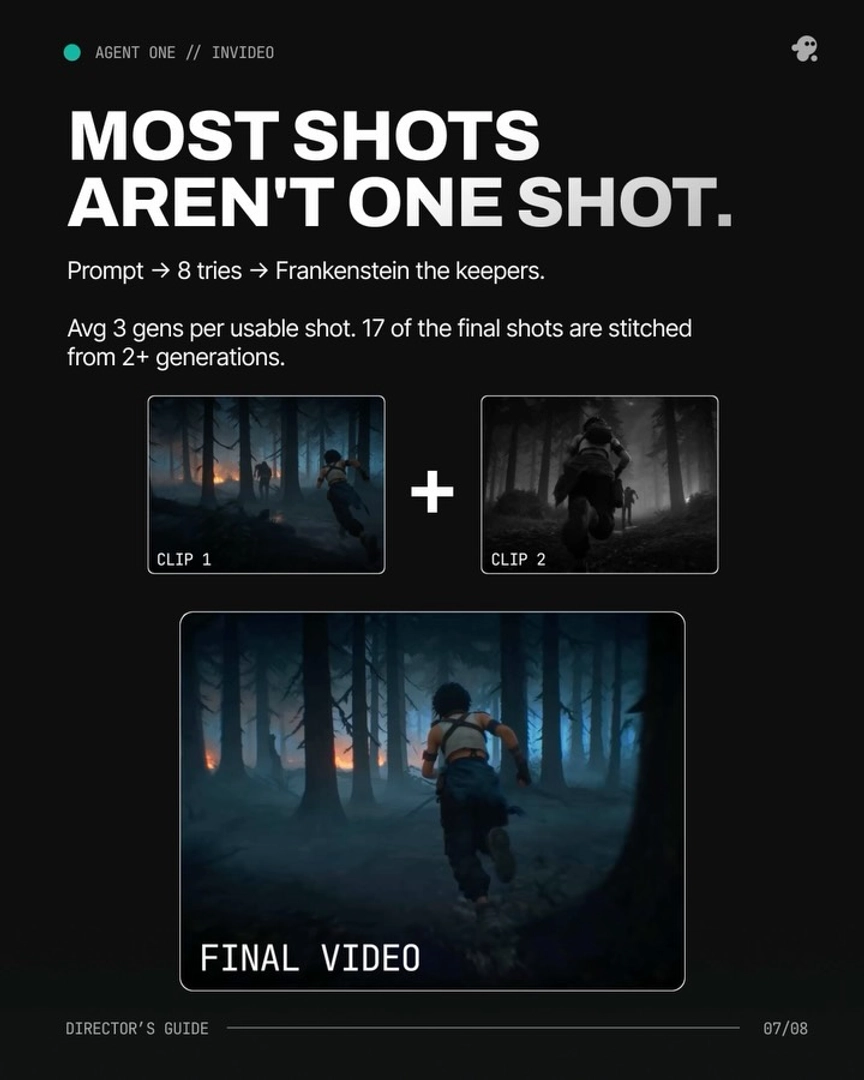
The credit follows the creative decisions, not the camera. Director credit attaches to whoever chose the story, the shots, the performances, and the cut — and in AI production that decision load is measurable. In one documented 3-minute animated episode, the team generated 164 clips and used 41 in the final cut, a ~25% selection rate, keeping an average of 5 seconds from each 15-second clip and stitching 17 final shots from two or more generations. Someone reviewed every take, rejected three out of four, and assembled the survivors — that is direction and editorial judgment by any definition. If your workflow looked like that — you briefed each shot, gave notes, rejected misses, chose takes — the credit is yours. Tools like the invideo agent formalize exactly this role: you direct in plain language and approve or reject every shot before it renders, which is the director's job description, not a prompt operator's.
Distinguish AI-assisted from AI-composed before you claim the role. If you supplied the story, references, shot-level direction, and the edit, your film is AI-assisted human work and director credit is standard — Credtent's Creative Origin framework draws this exact line between AI-assisted and AI-composed content. If you typed a single prompt and published the output with no shot selection or editorial pass, a directing credit overstates your contribution; credit the tool prominently and describe yourself as creator or producer instead.
Disclosure is separate from credit — do both. A platform AI label is not a credit and a credit is not a disclosure. Vimeo requires realistic AI-generated or AI-enhanced video to be labeled as such regardless of who directed it, and festival/submission platforms like PYLON require AI disclosure at intake. Toggle the label where the platform asks for it, and keep your director credit in the film's titles — one never replaces the other.
Follow the convention AI-native productions have already set. Documented AI films use auteur-style credit blocks: one episodic sci-fi production closes with the human creator credited as writer, director, and editor, with co-writers and the AI toolchain on their own line; another credits a director and co-director alongside the production tool; a third credits human collaborators separately for original score, sound design, foley, and cinematography support. The pattern is consistent — human names in the traditional roles, the tools credited the way productions credit cameras or software. A practical format: "Written & Directed by [Your Name] — Made with AI video tools" (or name the specific platform and models). Guild standards such as DGA possessory-credit rules don't yet cover AI-native production, so transparent self-attribution with a tool line is the current industry default — and it holds up whether your short cost $750 or $5,000, the documented range across five AI short film productions.
Watch some of these to see what works for you:
The real unlock isn't the tech. It's that the skill that makes this work isn't prompting — it's directing. And that doesn't come from a tutorial. It comes from being on set.
— invideo's creative team