What AI tools should each film crew role use — director, cinematographer, screenwriter, and editor?
Last updated July 27, 2026
Assign one AI agent per role inside the invideo agent: a screenwriter agent on Claude or ChatGPT for script and beats, a director / storyboard agent for shot lists and frames, a DOP agent routed to Kling 3.0, Veo, or Seedance 2.0 for cinematic motion, and an editor agent for assembly and a maker-checker pass. Wire them as a handoff chain — script → shot list → generated shots → cut.
invideo is an agentic video tool where every current model (Kling, Veo, Seedance 2.0, Recraft, Nano Banana, GPT-Image-2, plus upscalers) runs inside one workspace, so the four crew agents below all live in the same project and pass work between each other instead of you exporting between platforms.
Screenwriter agent — Claude or ChatGPT, then load the script into a creative producer agent Use Claude or ChatGPT for outline, beat sheet, and dialogue drafts — they remain the strongest LLMs for long-form narrative. Then upload the finished script into a creative producer agent inside invideo: "that's the main agent that sort of holds the understanding and the vision of the entire film," as invideo's creative team puts it. The creative producer holds script, shot breakdown, and character details as the central context every downstream agent inherits.
Director / storyboard agent — a storyboard sub-agent inside invideo, image models for frames Spin up a storyboard agent and a director's assistant agent in invideo. The storyboard agent visualizes shots before you give detailed direction; the director's assistant sequences them so the order is locked before any video is generated. For the actual frames, route portraits to Recraft (it produces pores, lines, stubble — the imperfections that make a face read real), and character sheets / environment plates to Nano Banana or GPT-Image-2 at four angles per character. Generate four options per asset, lock the winners, and only then move to video.
DOP / cinematographer agent — one agent per scene, routed to the right video model Assign a DOP agent per scene rather than one for the whole film — "I have multiple DOPs because each scene requires a different kind of eye." The invideo agent routes each shot to the model that fits: Kling 3.0 for native multi-shot cinematic sequences, Veo for realism and physics, Seedance 2.0 reference-to-video when you need character and location context carried across clips, Runway when you want explicit camera-motion control. You don't choose the platform per model — they're all available inside invideo, and the DOP agent picks. For complex sequences, deploy two DOP agents on the same scene in parallel.
Editor agent — assembly in your NLE, maker-checker pass in invideo Assemble the cut in your editor of choice. Then send the rough cut back to the invideo agent with an open "what's working, what's not" prompt — it checks pacing, sound design, and emotional-stage register against the loaded treatment and flags issues a human editor often misses (in one production, the agent caught that an entity reveal was running at the wrong emotional stage register the director hadn't spotted). Use a named upscale sub-agent for the final polish pass.
Wire them as a handoff chain, not parallel silos The sequence is fixed: creative producer holds the script → storyboard agent visualizes → director's assistant sequences → DOP agent(s) generate shots → editor assembles → maker-checker pass. Run agents on separate project pages so feedback to one doesn't contaminate another, but keep them all rooted in the same creative producer's context. Documented productions have run 6–8 agents in parallel this way, cutting a 2-minute brand promo to 3 days (vs. roughly 2 months traditional) and a 3-minute animated episode to 2 days with a 2-person team.
One honest limitation Shot-to-shot consistency is still the unsolved problem in AI video — the ASC has flagged it publicly. The crew-of-agents setup is what fights it: locked character sheets, locked world plates, and a creative producer holding context across every generation.
Watch some of these to see what works for you:
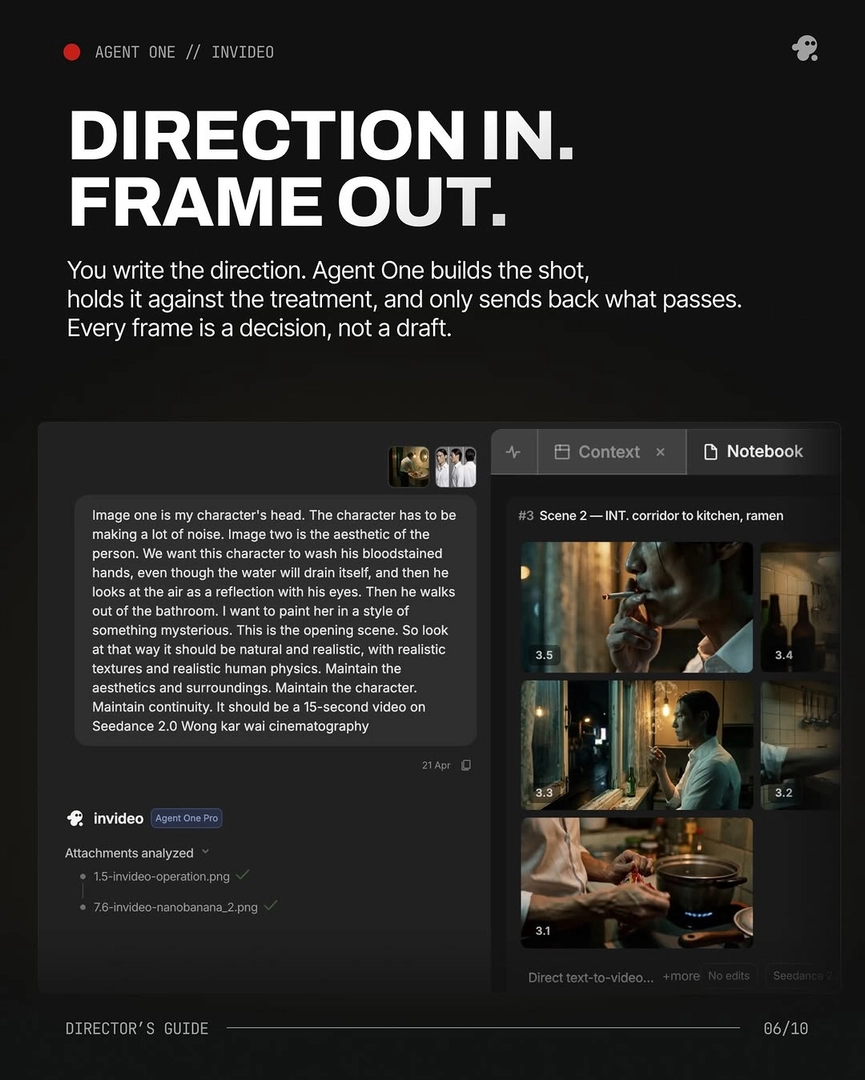
To really set up the context for the agent, I normally start off with the creative producer agent. That's where I'll give the script, or the shot breakdown, along with the characters. That's the main agent that sort of holds the understanding and the vision of the entire film.
— Hridaye, invideo's creative director