What is the best AI tool for making a short film on a tight budget?
Last updated July 27, 2026
For a tight-budget short film, the most cost-efficient setup is one agentic platform that holds context and routes shots to the right model — the invideo agent. Documented short films built this way landed at $750–$1,500 all-in (roughly $315–$750 per finished minute), versus $100,000–$500,000 for a traditional equivalent.
Use one tool that holds your whole production in context and routes each shot to the right model, rather than stitching together a separate generator, a separate voice tool, a separate enhancer, and paying a subscription to each. invideo is an agentic video creation platform with all the current video models (Runway, Veo, Kling, Seedance 2.0) and image models (Recraft, Nano Banana, GPT-Image-2) available inside it — so the invideo agent picks the model per shot and you pay credits for what you actually generate, not five monthly seats.
Here is what tight-budget short films have actually cost on this setup, pulled from documented productions:
Film | Length | Credits | Total cost | Per finished minute |
|---|---|---|---|---|
Wong Kar-wai style short | 70 sec | 3,000 | $750 | ~$643 |
James Wan style horror short | 90 sec | 4,100 | $870 | ~$580 |
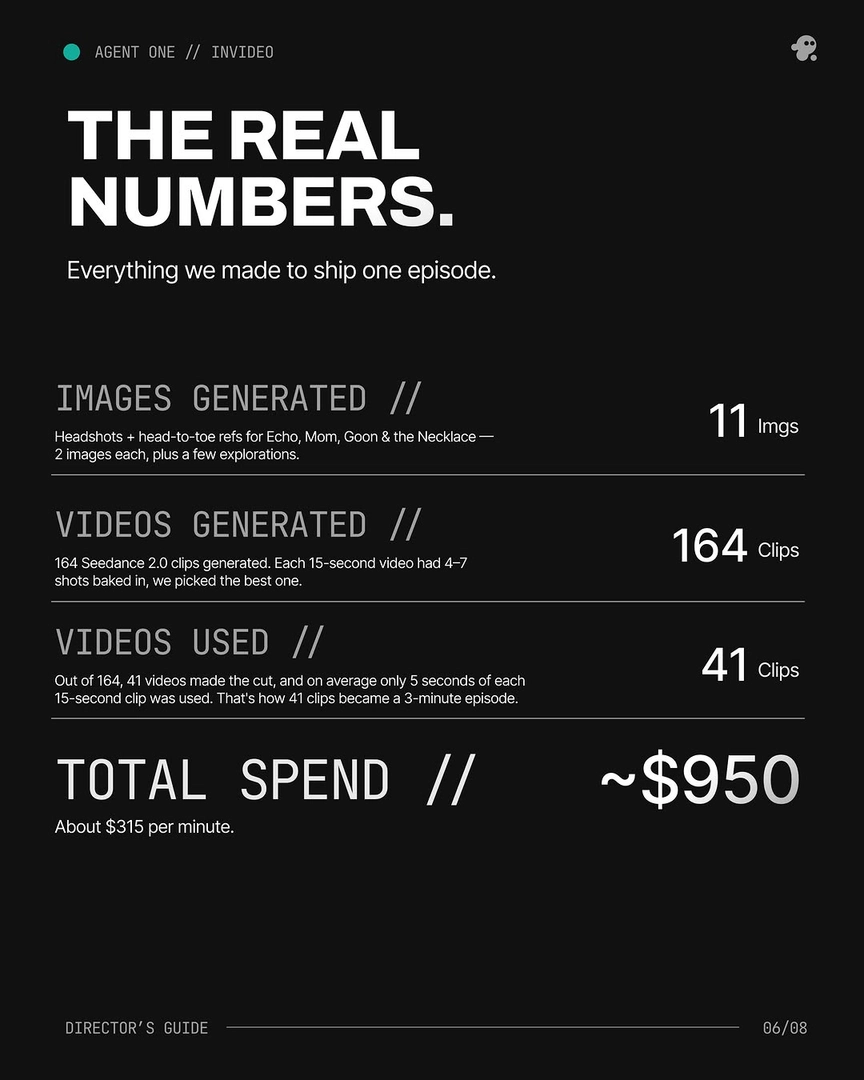
Arcane-style animated episode | 3 min | — | $950 | $315 |
Brand promo | 2 min | 6,000–6,500 | $1,500 | $750 |
Multi-location short with VFX | — | 20,000 | $5,000 | — |
That is a range of $315–$750 per finished minute across documented productions, against $100,000–$500,000 for a traditional shoot of comparable ambition — up to a 99.7% cost reduction on the brand-film comparison.
Budget the credits, not the seats. Plan for overgeneration: documented productions averaged 3 generations per usable shot, and only ~25% of generated clips made the final cut (41 of 164 on the Arcane-style episode). That is not waste — it is the iteration budget, and it is the line item that actually moves with your film's complexity. Character locking on the same production took ~5 generations per character, about $9.78 each.
A few tactical choices that keep the number down:
Run sub-agents in parallel, not extra subscriptions. Documented productions ran 6–8 sub-agents simultaneously inside one invideo workspace (a creative producer agent, a storyboard agent, DOP agents per scene, a costume agent). One platform, parallel work, one credit pool.
Lock references before you generate video. Generating four image options per character sheet and environment, then locking, is what kept the Wong Kar-wai short at $750 and the horror short at $870 — image generations are cheap, re-rolling video is not.
Approve shot-by-shot. Running the invideo agent in always-ask mode means credits only spend on prompts you greenlit.
Generate in your film's aspect ratio and delivery format from the start so you are not re-rolling shots for reframing.
On timeline: documented short films shipped in 2–5 production days with teams of 1–4 people. The 2-minute promo would have taken at least a week with manual prompting and roughly 2 months as a traditional shoot — about a 20x time reduction, which compounds the cost saving when you are paying yourself.
"2 guys. 2 days. No pre-production," Hridaye, invideo's creative director, said of the $950 / 3-minute Arcane-style episode — the minimum viable shape of a tight-budget AI short.
Beyond the platform choice itself: free or low-cost adjacent tools (a voice generator for VO, your existing NLE for the cut) pair fine with this — the spine is the agentic platform that holds your script, references, and shots in one context, because that is what stops you re-paying for the same work across disconnected tools.
Watch some of these to see what works for you:
2 guys. 2 days. No pre-production.
— Hridaye, invideo's creative director