What is the best AI workflow for producing an Arcane-style animated series on a low budget?
Last updated July 27, 2026
Produce an Arcane-style series for ~$315 per finished minute with a 2-person, 2-day-per-episode pipeline: feed ~64 Arcane frames into the invideo agent as a locked style block, lock 4 character sheets and key environments before any video, then generate the episode in 15-second Seedance 2.0 clips with shot-by-shot approval.
invideo is an agentic video creation tool that holds all current video and image models (Seedance 2.0, Kling, Veo, Runway, Recraft, Nano Banana, GPT-Image-2) behind one agent — so you stay on one platform across the whole series instead of stitching tools together.
Step 1 — Lock the Arcane style block once. Pull 60–70 frames from an Arcane episode, upload them in a single message to the invideo agent, and instruct it: "deeply understand this art style and save it into context for further generations." One documented Arcane-style production used exactly 64 frames. Then write a style block with hard negative constraints — "this MUST look and feel like Arcane animation — not live action, not photorealistic. Every surface has hand-painted brushstroke texture" — and prepend it to every prompt for the rest of the series. The style block, not the model, is what holds episode-to-episode consistency.
Step 2 — Lock characters and world before any video. Generate 4 options per character with Nano Banana or GPT-Image-2, pick one, and build a multi-angle character sheet (front, side, back, face close-up) per character. Budget for it: a documented production locked 4 characters and 1 prop in 11 images, averaging ~5 generations and ~$9.78 per character. Do the same for 2–4 hero environments. Without locked sheets and world plates, every clip drifts and your credit burn explodes.
Step 3 — Generate the episode in 15-second Seedance 2.0 chunks, Always Ask mode. Break the script into 15-second beats. For each beat, attach the relevant character sheet + environment plate + the locked style block, and run Seedance 2.0 in your delivery format. Use Always Ask mode so you approve each prompt before credits spend. Expect ~3 generations per usable shot and a ~25% selection rate — that overgeneration is a budget line, not waste. Each 15-second clip typically yields ~5 seconds of final footage, so plan generation volume accordingly (the reference episode generated 164 clips and used 41).
Step 4 — Stitch the best seconds across generations (Frankenstein shot assembly). Most final shots in AI animation are not single generations. In the reference Arcane-style episode, 17 of the final shots — over 40% — were stitched from 2+ generations of the same prompt. Cut the strongest 2–5 seconds from clip A, the strongest 3 seconds from clip B, and assemble them as one shot in your NLE. Build this into your plan from the start.
Step 5 — Model routing for the shots Seedance 2.0 can't carry. Where Seedance 2.0 reference-to-video falters on a multi-shot beat or a stylized camera move, route that beat to Kling (strong multi-shot sequences) or Veo, then return to Seedance 2.0 for the next beat. The invideo agent picks the model per shot, so you stay in one project. Light post (a touch of blur, grain, and a grade pass) brings the painterly clips closer to a finished Arcane frame.
Episodic continuity across the series. Treat episode 1's locked assets — the 64-frame style block, every character sheet, every environment plate, the negative-prompt list — as a reusable bible for episodes 2-N. Load that bible into a fresh creative producer agent at the start of each episode and the visual language carries forward without re-locking. Work act-by-act inside each episode (finish act 1 end-to-end before starting act 2) so the agent's context never drifts on a long script.
Real cost benchmarks across documented productions: $315–$750 per finished minute, $750–$5,000 total per short, 2–5 production days, teams of 1–4. The Arcane-style episode specifically landed at ~$950 for 3 minutes (~$315/min) with a 2-person team in 2 days, no pre-production. Budget a 10-episode season at roughly $3,000–$10,000 in credits at current pricing, depending on shot complexity and how aggressively you overgenerate.
As Hridaye, invideo's creative director, puts it: "Most shots aren't one shot. Prompt → 8 tries → Frankenstein the keepers." Plan for that and the math works.
Watch some of these to see what works for you:
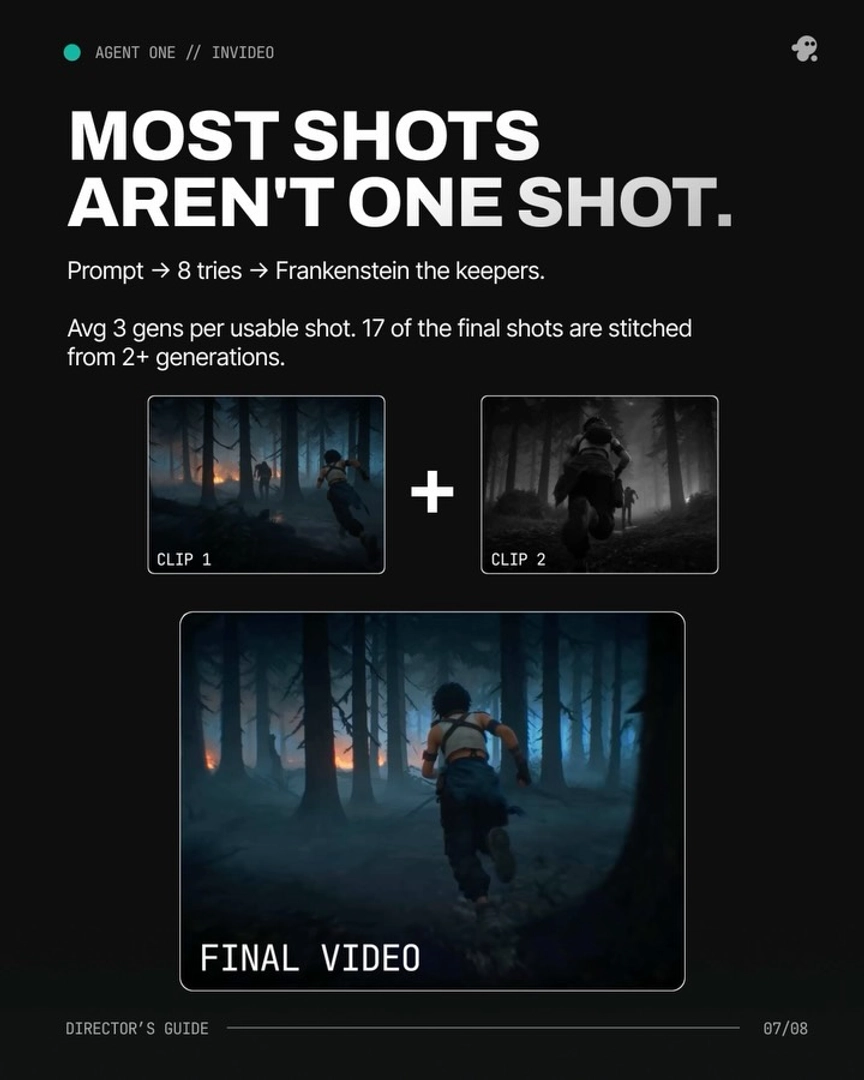
MOST SHOTS AREN'T ONE SHOT. Prompt → 8 tries → Frankenstein the keepers.
— Hridaye, invideo's creative director