What is the step-by-step workflow for producing an AI animated short film in 2 days?
Last updated July 27, 2026
A 2-day AI animated short film runs as five ordered phases: lock the visual style by uploading a batch of reference frames, lock character sheets, generate video in 15-second chunks with references attached to every prompt, overgenerate and select (only ~25% of clips survive), then stitch the best seconds into final shots. One documented 2-person production finished a 3-minute episode this way for ~$950.
Run the whole pipeline inside one persistent context so style and characters never drift between shots — invideo is an agentic video creation tool with all the current generation models available, so the invideo agent can hold your references and route each step to the right model.
Day 1, step 1 — lock the style. Upload a large batch of frames from your target aesthetic in a single message and instruct the invideo agent to save it to context. One documented production uploaded 64 frames from its reference show with the prompt: "I want you to deeply understand this art style and save it into context for further generations." Write the resulting style block with explicit prohibitions — "not live action, not photorealistic, every surface hand-painted" — and start every subsequent generation prompt with it.
Day 1, step 2 — lock character sheets. Generate reference images for every character and key prop before any video: 11 images covered 4 characters and 1 prop in the documented production, and locking one character took about 5 generation attempts (~$9.78 per character). For image work, Nano Banana handles character sheets well, with Recraft or GPT-Image-2 for portrait-style references — all available inside invideo, so you pick per task rather than per platform.
Day 1, step 3 — start generating video in parallel. With two people, one finishes character turnarounds while the other already generates shots. Produce video in 15-second segments in your film's aspect ratio — Seedance 2.0 is the documented model here because its reference-to-video input carries character context into each clip — and run the invideo agent in Always Ask mode so you approve every prompt and attached reference before credits are spent. Attach the character sheets and the style block to every single generation.
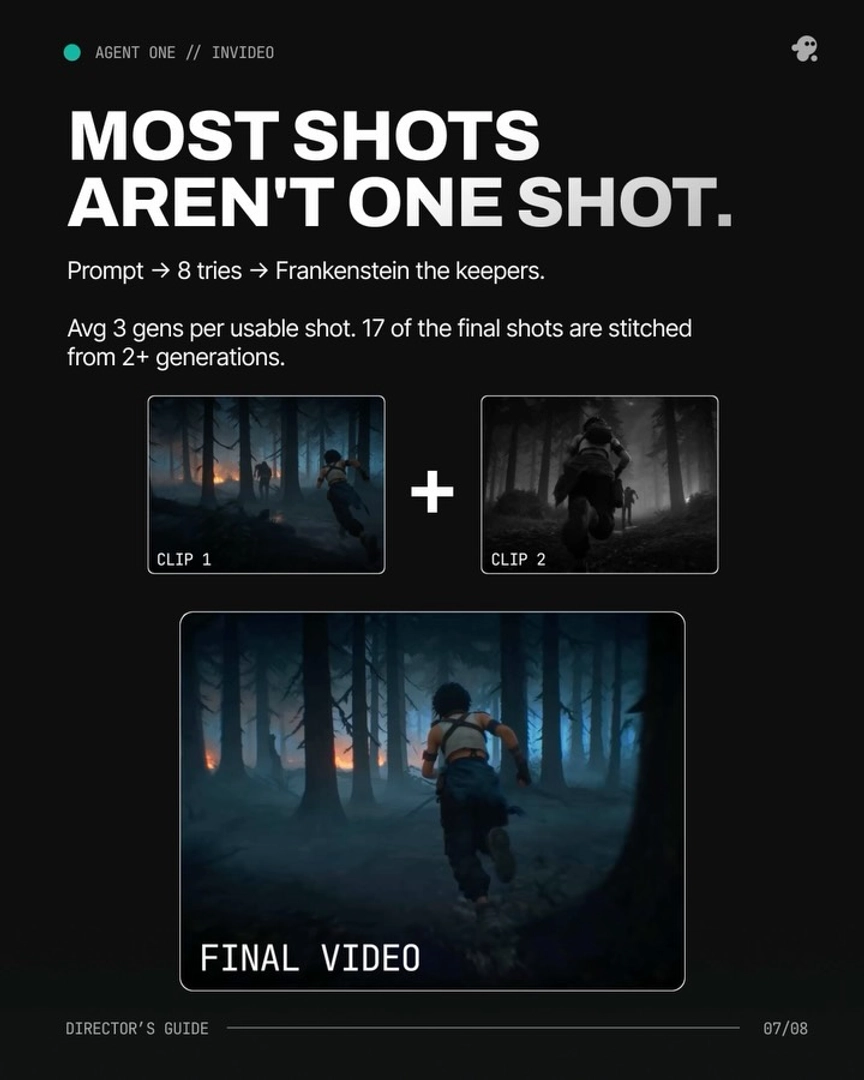
Day 2, step 4 — overgenerate, then select. Budget roughly 3 generations per usable shot and expect about 25% of clips to be editorially usable: the documented episode generated 164 clips, kept 41, and used on average only 5 seconds of each 15-second clip. Each clip typically contains 4–7 usable shot candidates, so treat generation as producing options to cut from, not finished shots — overgeneration is a deliberate budget line.
Day 2, step 5 — Frankenstein shot assembly. When no single generation delivers a complete shot, stitch the strongest seconds from 2 or more generations of the same prompt into one composite shot. In the documented episode, 17 of the final shots — over 40% — were assembled this way.
Day 2, step 6 — cut and finish. Assemble the selected segments into the final edit, then send the rough cut back to the invideo agent for an open-ended "what's working, what's not" pass — a review step that catches pacing and register errors and is the one most teams skip.
On budget: documented 2-day productions ran $750–$950 all-in depending on length and approach — a 70-second film at $750, a 90-second film at $870, and the 3-minute animated episode at $950, which normalizes to $315 per finished minute. Because the style block, character sheets, and yield math carry over project to project, the same 2-day, ~$950 cycle is repeatable as an episodic cadence rather than a one-off.
Watch some of these to see what works for you:
Out of 164, 41 videos made the cut, and on average only 5 seconds of each 15-second clip was used. That's how 41 clips became a 3-minute episode.
— invideo's creative team