What percentage of AI-generated video clips are actually usable in a final edit?
Last updated July 27, 2026
Roughly 25% of AI-generated clips make a final edit on documented productions — 41 of 164 Seedance 2.0 clips survived to cut on one 3-minute animated episode, and inside each surviving 15-second clip only ~5 seconds got used. Plan on ~3 generations per usable shot, and treat overgeneration as a budget line, not waste.
Use the 25% yield as your planning multiplier. On a documented 3-minute animated episode, a 2-person team generated 164 Seedance 2.0 clips and 41 made the final cut — a ~25% selection rate — and the average usable slice inside each 15-second generation was only 5 seconds. So to land 10 finished shots, plan for roughly 40 generations; to land a 3-minute episode, plan for ~160. Yield scales with how punishing your quality bar is — social-tier output runs much higher (60–85% in published benchmarks), professional narrative lands in the 40–60% band, and broadcast/commercial work drops toward 4–5% per published case studies.
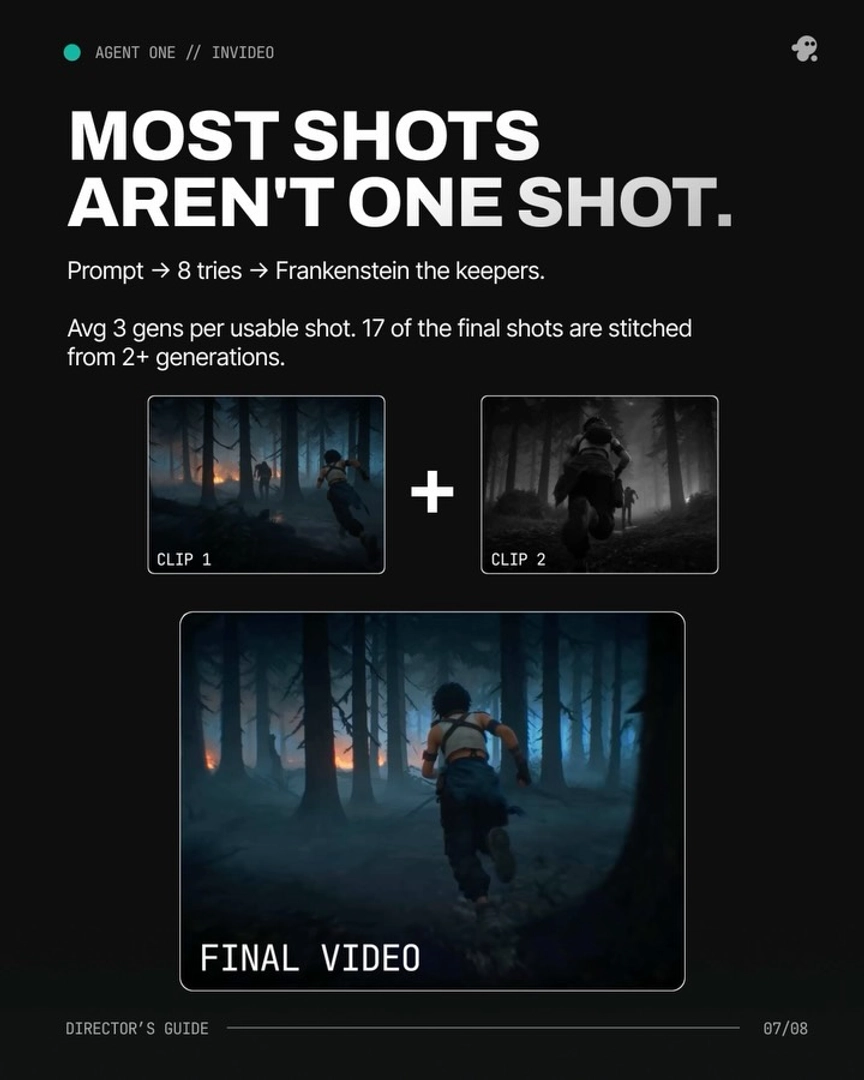
The per-shot math is tighter than the per-clip math. Across the same documented production, the average was 3 generations per usable shot, and 17 of the final shots were stitched from 2 or more generations — what the community calls a Frankenstein shot, where you take the strongest seconds from multiple generations and cut them into one composite. That means a chunk of your "usable" output isn't whole clips at all; it's the best 2–4 seconds of an otherwise rejected generation. Budget for this: if 40%+ of your final shots will be composites, your raw generation count needs to absorb that.
Character and asset locking sits upstream of clip yield and protects it. The same production needed ~5 generations to lock each character's visual identity (~$9.78 per character) before any shot generation began — locking sheets and environment references first is what keeps your per-shot ratio at ~3 instead of blowing out to 8–10 when consistency drifts mid-scene.
Cost-per-finished-minute is the number worth planning against, not cost-per-generation. Across four documented productions with known length and spend: $315/min on a 3-minute animated episode ($950 total), ~$580/min on a 90-second horror short ($870 total), ~$643/min on a 70-second short ($750 total), and $750/min on a 2-minute brand promo ($1,500 total) — a $315–$750 per finished minute range that already absorbs the 75% of generations that get cut. As Hridaye, invideo's creative director, puts it: "Out of 164, 41 videos made the cut, and on average only 5 seconds of each 15-second clip was used. That's how 41 clips became a 3-minute episode."
Two levers move yield. First, model routing: Kling 3.0 handles multi-shot sequences natively, Seedance 2.0 reference-to-video carries character and location context across clips (which is why it dominates continuity-heavy work), and Veo and Runway each have shot types they're stronger on. The invideo agent holds all of these and routes each shot to the right model, so you're not paying the yield tax of forcing one model to do everything. Second, specificity: locking character sheets, environment refs, and a style block before generation — and running shot-by-shot approval so you only spend credits on prompts you've already vetted — is what keeps the editorial yield closer to 25% than to 10%.
Beyond the yield number itself: the practical planning frame is overgeneration as a line item. "Most shots aren't one shot. Prompt → 8 tries → Frankenstein the keepers" is the working reality — so when you scope a project, multiply your target shot count by ~4 for total generations, by ~3 for usable-shot generations, and assume ~40% of finals will be stitched composites.
Watch some of these to see what works for you:
Out of 164, 41 videos made the cut, and on average only 5 seconds of each 15-second clip was used. That's how 41 clips became a 3-minute episode.
— Hridaye, invideo's creative director