Why do AI video creators generate far more clips than they actually use?
Last updated July 27, 2026
AI creators overgenerate because each clip costs cents, only about 25% of generations are editorially usable, and the cheapest path to a great cut is more raw options. Overgeneration is a deliberate budget line that buys editorial choice, absorbs model inconsistency, and replaces the reshoot — not waste.
Treat overgeneration as a budget line, not a failure mode. The marginal cost of one more take is near zero — pennies in credits versus the hours and dollars a traditional reshoot demands — so the rational move is to generate wide and select narrow. The yield numbers back this up: across one documented 3-minute animated episode, 164 Seedance 2.0 clips were generated and only 41 made the final cut — roughly a 25% selection rate — and on average just 5 seconds of each 15-second generation was actually used. A separate ~90-second horror short ran ~400 video generations and 30 image generations to land its final shots. The math is consistent: plan for ~3 generations per usable shot, and expect a meaningful share of final shots to be stitched from two or more takes (17 of the final shots in the animated episode were composites).
You're buying editorial optionality. More raw material means the editor cuts to the best 5 seconds of every 15-second clip instead of defending a mediocre one. Each generation is effectively 4–7 micro-shot candidates inside one render, so overgeneration multiplies the actual shot pool far beyond the clip count. That's how 41 kept clips became a tight 3-minute episode rather than a padded one.
You're absorbing model inconsistency. Current video models drift on character likeness, hand contact, eye lines, and motion across long takes. Generating several variants per prompt — and routing the same shot through different models where it helps (Veo, Kling, Seedance 2.0 each have different strengths) — is faster and cheaper than fighting one bad generation. invideo is an agentic video tool with all the current generation and upscaling models built in, so the invideo agent routes each shot to whichever model handles it best instead of forcing you to pick one upstream.
You're replacing the reshoot. Regenerating a failed 5-second beat costs cents and minutes; a traditional pickup costs a day and a crew. That asymmetry is what makes overgeneration economically obvious. Documented productions land at $315–$750 per finished minute all-in ($315/min on a 3-minute animated episode at $950 total; $750/min on a 2-minute brand promo at $1,500 — versus $100,000–$500,000 traditional), and a meaningful slice of that budget is iteration, not waste.
You're A/B testing creative direction. Generating multiple interpretations of an abstract beat, several costume options against a mood brief, or grids of world frames lets the director pick rather than guess. As Hridaye puts it, "Every director in real life always wants options." Image generation costs little, so grids of 3–4 options per round are standard, and on character locks teams budget ~5 generations per character (~$9.78 each) before committing.
A practical planning rule from the documented productions: for every finished minute, expect roughly 50–60 generated clips and a ~25% keep rate. Build that into the credit budget from the start and overgeneration stops looking like waste — it looks like coverage.
Watch some of these to see what works for you:
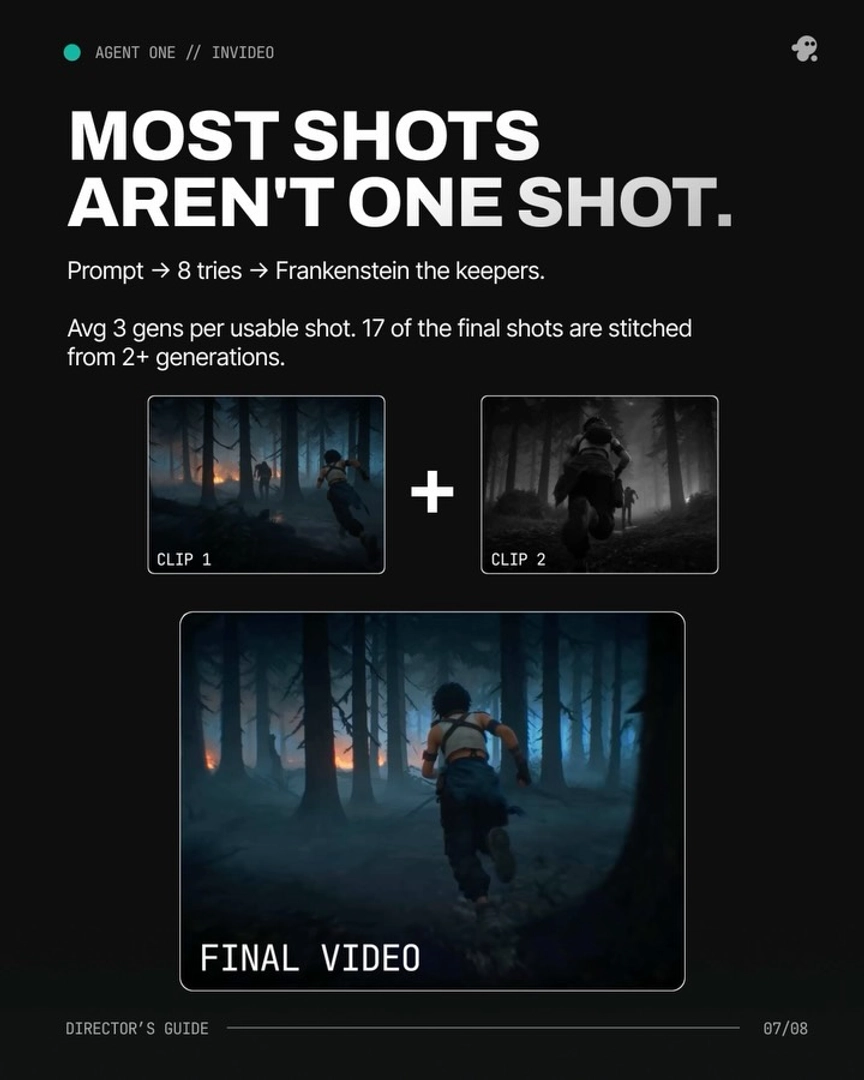
MOST SHOTS AREN'T ONE SHOT. Prompt → 8 tries → Frankenstein the keepers.
— Hridaye, invideo's creative director