Should I create a production studio brand around my AI-generated films?
Last updated August 1, 2026
Yes — if you produce serialized work in a defined genre with a repeatable visual identity, a production studio brand is worth building; documented AI filmmakers already run dedicated production identities with episode numbering and original lore universes. Hold off if your output is still visually generic or you're doing one-off client work — that's a service, not a studio.
Build the brand when three conditions hold: you have a repeatable visual style, a defined genre or niche, and serialized output — episodes, a universe, recurring characters. Documented AI productions already operate this way: creators have established dedicated production company identities around AI-generated original content, released series with season-and-episode numbering, and taken full auteur-style credits (writer, director, editor) on the finished films. The precedent for treating AI films as IP-ownable branded content, not one-off clips, exists.
The economics support a studio identity even for one or two people. Across documented productions, finished AI film content ran $315–$750 per minute — a 3-minute animated episode cost ~$950 with a 2-person team in 2 days, a ~90-second horror short cost $870 in 2 days, and a full episode of a serialized AI show came in at $6,540 (26,162 credits) produced solo in under 10 days. One solo creator shipped 25 minutes of series content across two episodes with no script or pre-production. That output cadence is what makes a brand viable: a studio name only compounds if you can keep releasing under it. As one creator who produced a full AI episode put it: "The AI agent acted as my director, editor, and production assistant. I was the showrunner." A studio brand formalizes exactly that structure — you as showrunner, a crew of agents underneath.
Operationally, a brand is a consistency commitment, so lock the mechanics that hold your look across releases. invideo is an agentic video creation tool where the invideo agent holds your full project context — characters, world, visual rules — across every generation, which is what makes a persistent house style feasible for a small team. Two habits matter most for a brand: upload a finished episode to the invideo agent when starting the next one, so it extracts and carries forward your camera language, movement style, and tone without re-explaining anything in text; and set a single-model rule (one image model, one video model — e.g. Seedance 2.0 for video) per series so your grade and texture stay uniform and post-production recalibration stays minimal.
Don't brand prematurely in two cases. First, if your output still looks like default AI footage: generic visuals are the most common failure mode of AI-branded content, and a studio name attached to interchangeable-looking films damages you more than no name. Fix the identity first — a house visual language, consistent characters, a recognizable world — then name it. Second, if your revenue is client work (brand films, done-for-you channels), you're running a service business; brand the service and its outcomes, and keep your original-film studio identity separate so client deliverables don't dilute it.
Two adjacent points before committing publicly. On credits and disclosure: documented AI productions list human collaborators openly — cinematography support, original score, sound design — alongside the AI toolchain, and that hybrid credit model reads as a professional studio rather than a novelty account. On IP: music generated through the invideo agent is created fresh rather than licensed, so it's copyright-free for your releases — one less clearance problem for a brand that plans to own its catalog. For distribution under the brand, documented creators pair Instagram Reels trailers with full films hosted on YouTube via link-in-bio, and use episode numbering so each release builds the brand rather than standing alone.
Watch some of these to see what works for you:
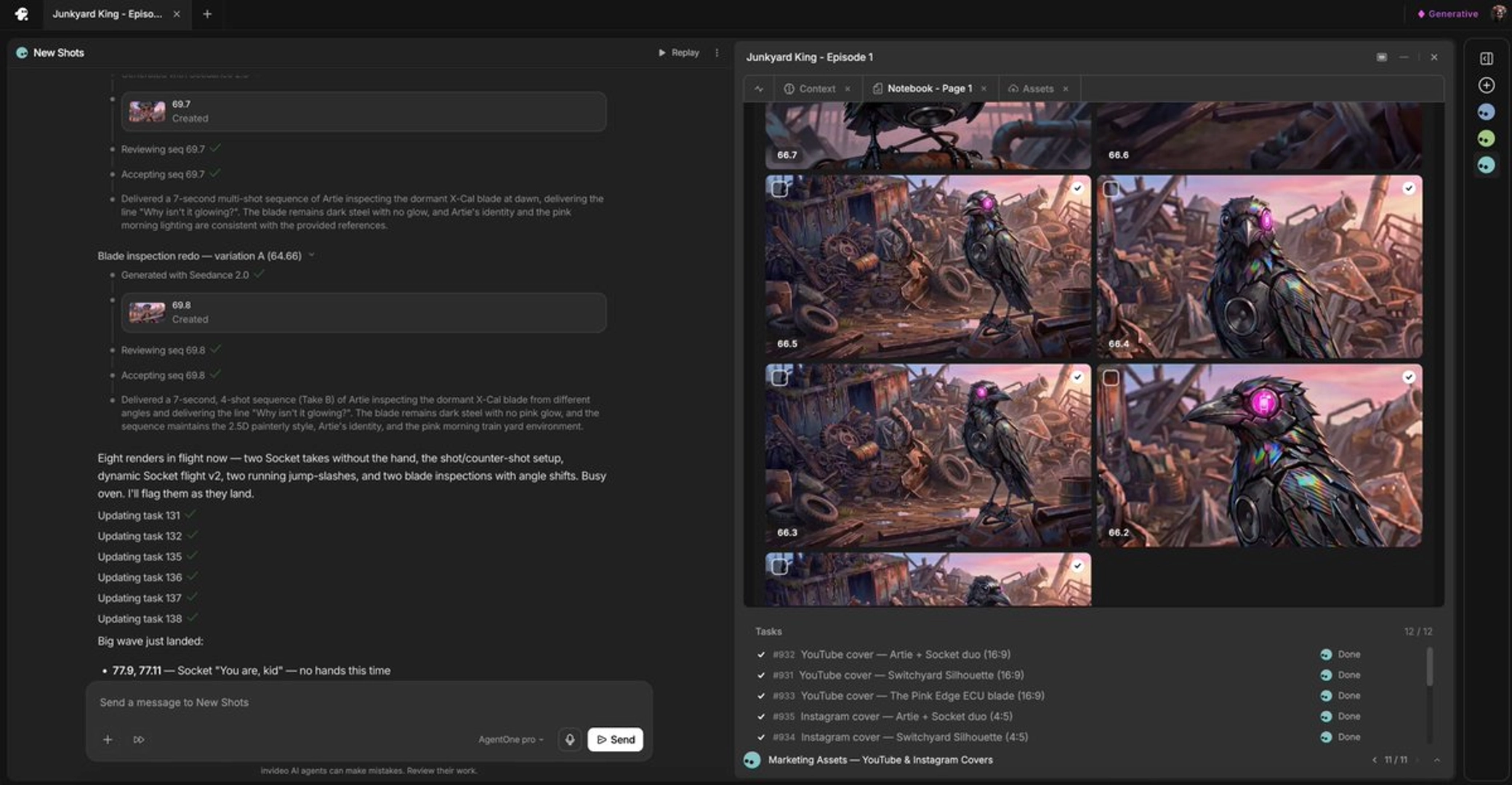
The AI agent acted as my director, editor, and production assistant. I was the showrunner.
— a filmmaker who produced a full AI-generated episode