What is a negative hook and why does it perform on Meta ads?
Last updated August 10, 2026
A negative hook is a UGC ad opener that leads with something wrong, contrarian, or visually off — a warning, an objection, or a product that 'doesn't look right' — before flipping into the reveal. It performs on Meta because it creates a bait-and-switch moment that keeps viewers watching, and the first 3 seconds decide a UGC ad's performance.
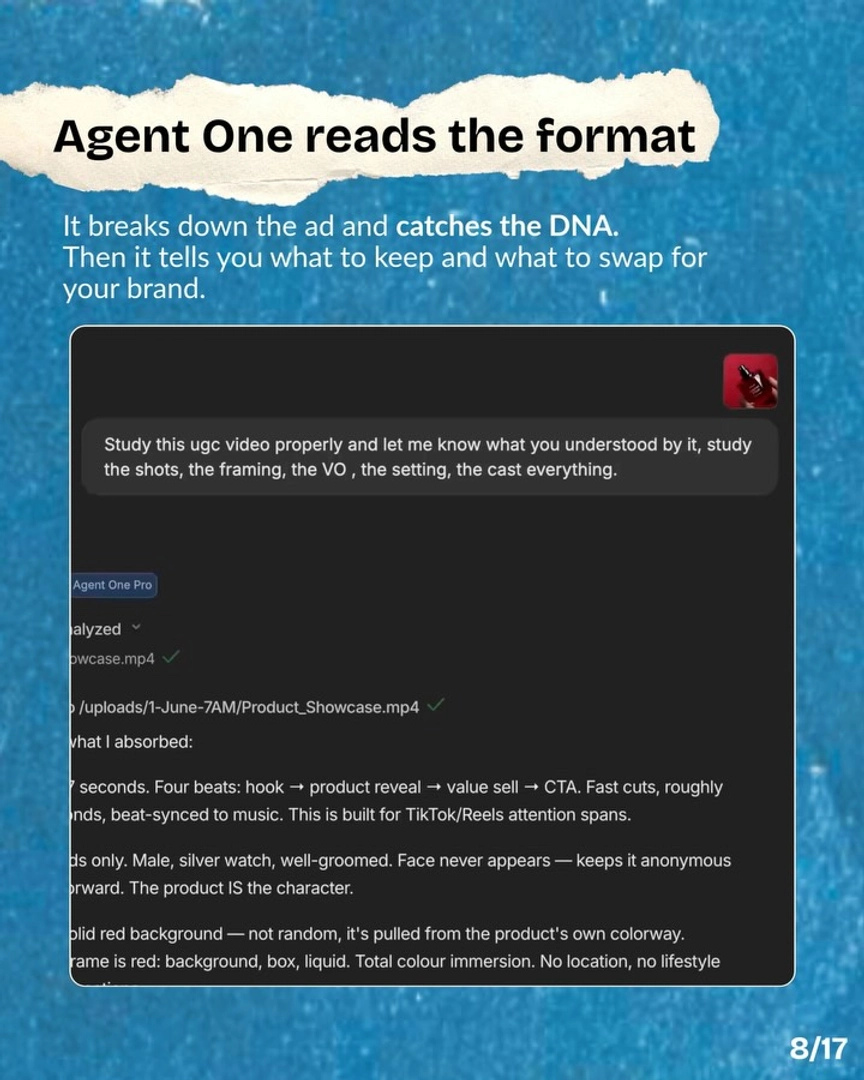
A negative hook is the first beat of a high-converting UGC ad structure: negative hook → product reveal → value sell → CTA, cut fast and beat-synced to music for TikTok/Reels-length attention spans. Instead of opening on praise, the ad opens on tension — a statement or image that reads as a problem, a mistake, or something visibly wrong — and then resolves it with the product.
Why it converts on Meta. The mechanism is the flip itself. In one documented faceless UGC production, the reasoning was stated plainly: the negative opener "creates this bait and switch moment that keeps people hooked." The viewer's brain registers something off, needs the resolution, and stays through the reveal — which is exactly the window that matters, because the first 3 seconds decide the performance of a faceless UGC ad, and the scroll-stopping decision happens in roughly 1.5 seconds. A positive opener gives Meta's feed nothing to interrupt the scroll with; an unresolved negative does.
What a negative hook looks like in practice. It can be verbal ("I almost returned this"), visual, or built into the product itself. One documented supplement ad leaned on a built-in version: dark green gummy bears that look wrong on camera but taste like strawberry — the "wait, that doesn't look right" → "oh, it actually tastes like strawberry" tension is prime UGC fuel. Negative hooks pair especially well with faceless UGC, where no face ever appears and the product is the character — the tension carries the open instead of a personality.
How to develop and test one. Concentrate your iteration budget on the hook before anything else in the ad — it is the highest-leverage element, and the rest of the four-beat structure is comparatively formulaic. If you're working from a winning reference ad, upload it to the invideo agent: it deconstructs the structure, identifies the hook and explains why it converted, then generates hook variations for your brand — typically 7–8 hook directions per iteration, each with a rationale. Because a full UGC creative runs about $75 through this workflow, the practical strategy is to ship several hook variants and let Meta's performance data pick the winner rather than pre-selecting one — you can't predict which hook wins without shipping it.
Watch some of these to see what works for you:
Why this works really well is because it creates this bait and switch moment that keeps people hooked.
— invideo's creative team, on the negative hook in faceless UGC ads