AI Film Production Cost: What an AI Short Film Actually Costs to Make
July 15, 2026
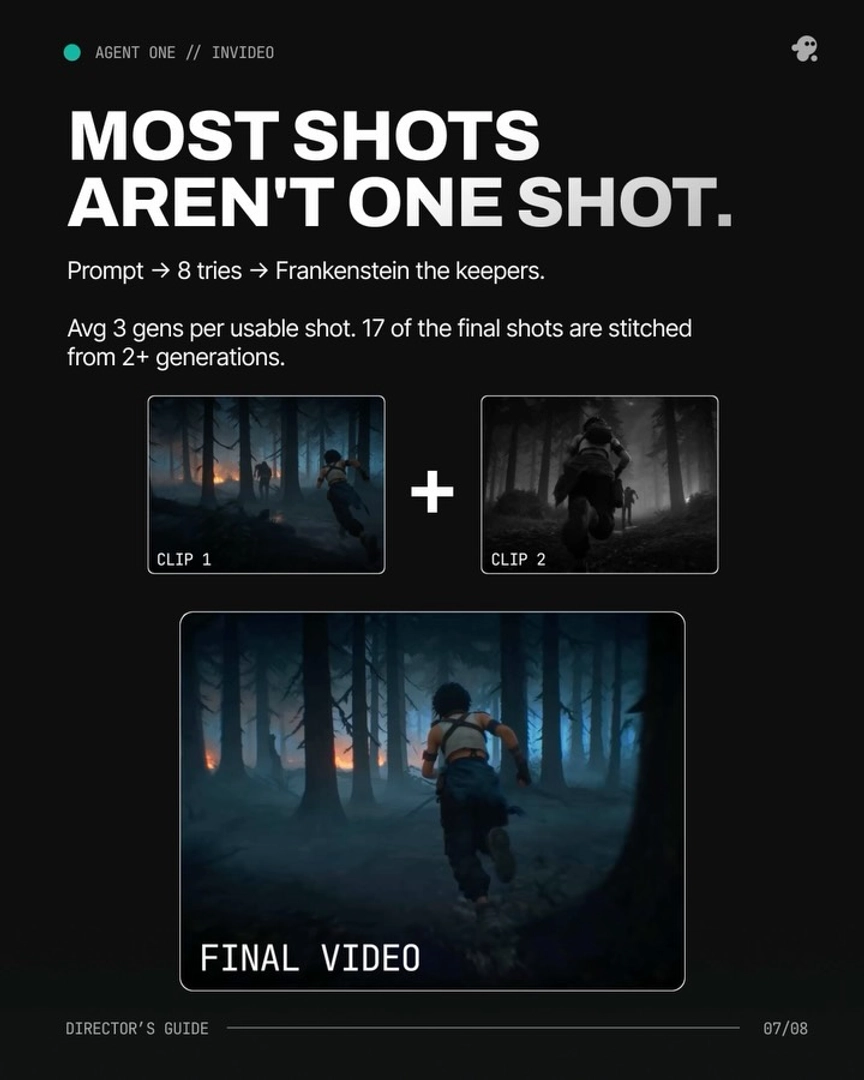
Documented AI short films cost $750 to $5,000 total and $315 to $750 per finished minute, made in 2 to 5 days by teams of 1 to 4, up to 99.7% cheaper than a traditional shoot. Budget for a 25% editorial yield (164 clips generated to land 41) at roughly three generations per usable shot.
Documented AI short films cost $750 to $5,000 total and $315 to $750 per finished minute, produced in 2 to 5 days by teams of 1 to 4 people — up to 99.7% cheaper than a traditional shoot of the same scale. The one budgeting rule that separates accurate estimates from blown budgets: plan for a ~25% editorial yield.
What an AI short film actually costs
Across five documented productions made end-to-end with the invideo agent, total spend ranged from $750 to $5,000, with cost per finished minute landing between $315 and $750 depending on team, length, and approach:
Production | Length | Total cost (USD) | $ / finished minute | Days | Team size | Credits |
|---|---|---|---|---|---|---|
70-second short film | 70s | $750 | ~$643 | 2 | — | 3,000 |
90-second horror short | 90s | $870 | ~$580 | 2 | — | 4,100 |
3-minute animated episode | 3 min | $950 | $315 | 2 | 2 | — |
2-minute brand film | 2 min | $1,500 | $750 | 3 | 1 | 6,000–6,500 |
5-day sprint short | — | $5,000 | — | 4–5 | 4 | 20,000 |
The takeaway: documented productions ran $315–$750 per finished minute, and the variance is natural — different teams, different shot complexity, different ambitions. The cheapest per-minute figure on record is the 3-minute animated episode at $315 per finished minute, made by a 2-person team with no pre-production. The most expensive total, the $5,000 sprint short, bought multiple international locations, VFX work, and a long-take sequence — a budget its team described as ridiculous value for what it delivered. At the top of the comparison, the same brand film that cost $1,500 in AI production would have run $100,000–$500,000 as a traditional shoot — a cost reduction of up to 99.7%.
How credits map to dollars
invideo productions are metered in credits, and the documented productions give you four real conversion points:
3,000 credits / $750 — the 70-second short film (2 days, all image and video generations included)
4,100 credits / $870 — the 90-second horror short (400 video gens, 30 image gens)
6,000–6,500 credits / $1,500 — the 2-minute brand film (3 days, one person running 8 agents)
20,000 credits / $5,000 — the 5-day sprint short (4 team members, multiple locations, VFX)
Across all four, credits convert at roughly $0.21–$0.25 per credit at the volumes these productions bought. For current rates and plan tiers, check invideo pricing — but for planning purposes, the working numbers are: a 2-day, sub-2-minute short consumes 3,000–4,100 credits; a polished brand piece runs 6,000–6,500; a multi-location, VFX-heavy sprint can consume 20,000. Within those totals, image generation is cheap relative to video — the animated episode locked each character's visual identity at roughly $9.78 per character, a rounding error against the video budget. Spend freely on images to lock references; spend carefully on video.
What drives the cost difference between productions
Four variables explain why one production lands at $315 per minute and another at $750.
Team size and parallelism. Documented teams ranged from 1 to 4 people, and headcount matters less than how many agents run at once. The 2-minute brand film was produced by one person running 8 specialist agents simultaneously across separate project pages — creative producer agent, casting agent, DOP agents, a director's assistant — in 3 days. The $5,000 sprint short used 4 people, each running up to 6 agents across 3 parallel projects. Parallel agent deployment compresses days, and days are where labor cost lives even when generation credits are fixed.
Shot complexity. Multi-character contact shots — bodies, props, and ropes interacting in frame — break video models faster than almost anything else, and POV shots remain among the hardest shot types to land. One production had a multi-character carry setup in 75% of its frames; shots like these consume well above the per-shot generation average. A dialogue film in static interiors will cost meaningfully less per minute than an action piece with physical contact.
Pre-production approach. The animated episode ran with zero pre-production and absorbed the iteration cost during generation. The 5-day sprint spent its entire first day locking cast, costumes, look-and-feel, and world images before generating a single video clip. Both work; locking references up front shifts cost from wasted video generations to cheap image generations.
Length and amortization. Fixed costs — character locking, world references, style setup — amortize over runtime. That's part of why the 3-minute episode hit $315/minute while the 70-second film landed near $643/minute on a 2-day schedule.
Model routing matters less than you'd expect for budgeting, because the invideo agent carries all current video models — Veo, Kling, Seedance 2.0 — and routes each shot to the right one, so model choice is a quality decision inside one credit pool rather than a separate platform expense.
How this compares to traditional production
The cleanest documented comparison is the 2-minute brand film: a traditional live-action production of the same piece was estimated at $100,000–$500,000 over roughly 2 months. The AI production delivered it for $1,500 in 3 days — up to a 99.7% cost reduction and a ~20x time reduction. Even the manual-prompting alternative (no agent orchestration, hand-built prompts per shot) was estimated at a week minimum for the same output; the agent workflow cut that to 3 days.
The structural reason the gap is this large: AI production removes location, crew, equipment, and physical logistics entirely, leaving only generation credits and the team's time. What it does not remove is iteration — which is why the honest comparison is $315–$750 per finished minute including overgeneration, not a theoretical per-clip price. For the full breakdown of where traditional budgets go and where AI budgets go instead, see our analysis of AI vs traditional cost.
One caveat for accuracy: these numbers cover production through final cut for short-form work. They scale linearly with runtime only if shot complexity stays constant — a 10-minute film with heavy multi-character action will not simply cost 10x the per-minute floor.
FAQ
How much does an AI short film cost?
Documented AI short films cost $750 to $5,000 total. The low end is a 70-second film made in 2 days for $750; the high end is a 4–5 day, 4-person production with international locations and VFX for $5,000. Most sub-3-minute projects land under $1,000.
What is the cost per finished minute of AI video?
Across four documented productions with known length and cost, the range is $315–$750 per finished minute: $315/min for a 3-minute animated episode, ~$580/min for a 90-second horror short, ~$643/min for a 70-second film, and $750/min for a 2-minute brand film. Longer runtimes amortize setup costs and trend cheaper per minute.
How many credits does an AI short film use?
Documented productions consumed 3,000 credits ($750) for a 70-second film, 4,100 credits ($870) for a 90-second short, 6,000–6,500 credits ($1,500) for a 2-minute brand film, and 20,000 credits ($5,000) for a multi-location sprint short. That works out to roughly $0.21–$0.25 per credit at those volumes.
How does AI film cost compare to traditional production?
A documented 2-minute brand film cost $1,500 in 3 days with AI versus an estimated $100,000–$500,000 over 2 months traditionally — up to a 99.7% cost reduction and roughly 20x faster. The savings come from eliminating locations, crew, and equipment; iteration cost remains and must be budgeted.
What is the cheapest documented AI short film?
The cheapest total is a 70-second short film at $750 (3,000 credits, 2 days). The cheapest per finished minute is a 3-minute animated episode at $315/minute — $950 total, with no pre-production.
How much does a 2-minute AI brand film cost?
A documented 2-minute brand film cost $1,500 (6,000–6,500 credits) and took 3 days, produced by one person running 8 specialist agents in parallel inside invideo. The traditional equivalent was estimated at $100,000–$500,000 over roughly 2 months.