Can AI video generators produce anime-style animation with traditional frame aesthetics like on-twos and smears?
Last updated July 27, 2026
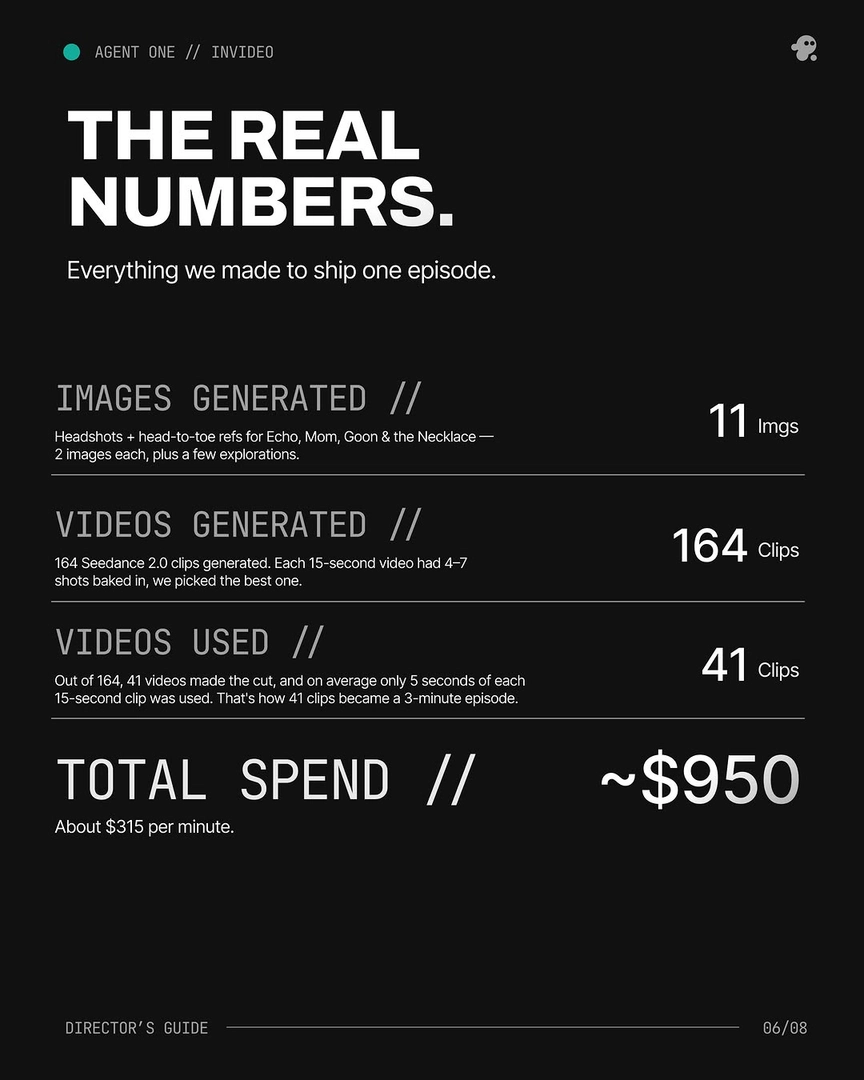
Yes. Seedance 2.0 already preserves the stylized 2–3 frame anime aesthetic — motion held on twos and threes — in clean HD output, and a documented 2-person production used it to make a 3-minute hand-painted Arcane-style episode in 2 days for ~$950. Smears and timing control come from locked style context plus editorial selection, not raw prompting.
Start with model choice, because frame aesthetics are model-dependent. Seedance 2.0 handles anime-inspired movement natively, "maintaining that stylized 2-3 frame aesthetic" that gives traditional animation its feel — that on-twos quality survives generation rather than being smoothed into fluid photoreal motion. Kling generates multi-shot sequences natively, and Seedance 2.0 reference-to-video carries style context across clips. invideo is an agentic video creation tool with all of these models available, so the invideo agent routes each shot to the right one instead of you committing to a single model.
Once the model is set, lock the style before generating anything. Upload a batch of frames from your target aesthetic in one message and instruct the agent to save it to persistent context — one documented production uploaded 64 reference frames with the prompt "I want you to deeply understand this art style and save it into context for further generations." Make the style block explicitly prohibit photorealism: that same production's block read "This MUST look and feel like Arcane animation — not live action, not photorealistic. Every surface has hand-painted brushstroke texture." Then prepend that block to every generation prompt without exception. Expect to enforce hard constraints iteratively: in one painterly 2.5D project, "no outlines" required aggressive negative prompting plus multiple generation passes — negative prompts alone don't hold a frame aesthetic.
Smears specifically respond to encoded motion rules, not one-off prompt words. Write your motion grammar — smear frames on fast actions, slow-shutter blur behavior, held frames on impact — into the style document the invideo agent keeps in context; in one documented production the agent applied a slow-shutter motion smear effect straight from page 17 of its loaded style document without being explicitly prompted. For effects animation, specify the frame behavior in animation language: the prompt "The arcs must change shape EVERY FRAME — like hand-drawn cel animation of electricity" produced dynamic frame-by-frame variation where generic VFX prompts returned static painted-on glows.
Budget for selection, because the traditional feel is partly editorial. The Arcane-style episode generated 164 Seedance 2.0 clips and used 41 — a ~25% selection rate, averaging 3 generations per usable shot and about 5 seconds kept from each 15-second clip. When no single generation nails the motion, use a Frankenstein shot: stitch the best seconds from two or more generations of the same prompt into one shot — 17 of that episode's final shots were composited this way. You're choosing the takes where the timing reads as animation, and cutting the rest.
Finish with a light post pass if you want period-accurate texture: subtle film grain, targeted color grading, and intentional small imperfections in your editor recreate the CRT/VHS warmth of 90s broadcast anime on top of the generated footage. As one creator put it, the goal is to capture a feeling, not just replicate an art style.
The proof this holds at production scale: that documented episode was made by 2 people in 2 days with no pre-production, at roughly $315 per finished minute.
Watch some of these to see what works for you:
What I especially love about Seedance is how well it handles anime-inspired movement, producing clean HD animations while maintaining that stylized 2-3 frame aesthetic that gives the series its traditional feel.
— a filmmaker producing a documented AI-animated anime series