Why are faceless UGC ads easier to replicate with AI than face-led ones?
Last updated August 10, 2026
Faceless UGC ads are easier to replicate with AI because they remove the single most fragile consistency element: the human face. A face-led ad must hold the same face, lip-sync, and voice across every shot; a faceless ad only has to hold the product and the look — both solvable with reference images fed once to an AI agent.
Start with what a face-led ad demands. Three visual elements must stay identical across every shot — the same face, the same product, the same look — and if any one drifts, the ad reads as fake. The face is the element AI models drift on most: first-pass generated faces come out too clean and need explicit instructions for natural flaws and real-world skin texture, every dialogue shot needs lip-sync generation against a locked character reference, and the voice has to be locked before any dialogue is generated, then cloned for narration shots — with audio-similarity checks (one documented workflow auto-regenerates the track if vocal drift exceeds a 1.5% variance threshold). A full character UGC ad — on-camera talking, product B-roll, and a green-screen composite — is documented as the format requiring the most machinery to rebuild with AI: one 40-second reference had to be broken into four separate generation segments (A-roll, B-roll, composite, hook) because video models cap each generation, then stitched back together.
A faceless ad deletes almost all of that machinery. The face never appears — the product is the character — so the consistency problem collapses from three elements to two: product and look. Product consistency is solvable at the source with a product sheet: upload every packaging layer from multiple angles, including close-ups and a shot against a human hand so the model learns true scale. The voiceover runs as an overlay rather than lip-synced audio, which removes lip-sync generation, voice locking, and drift checking entirely. Hands, product close-ups, and B-roll are exactly the shot types AI renders convincingly without a persona to anchor.
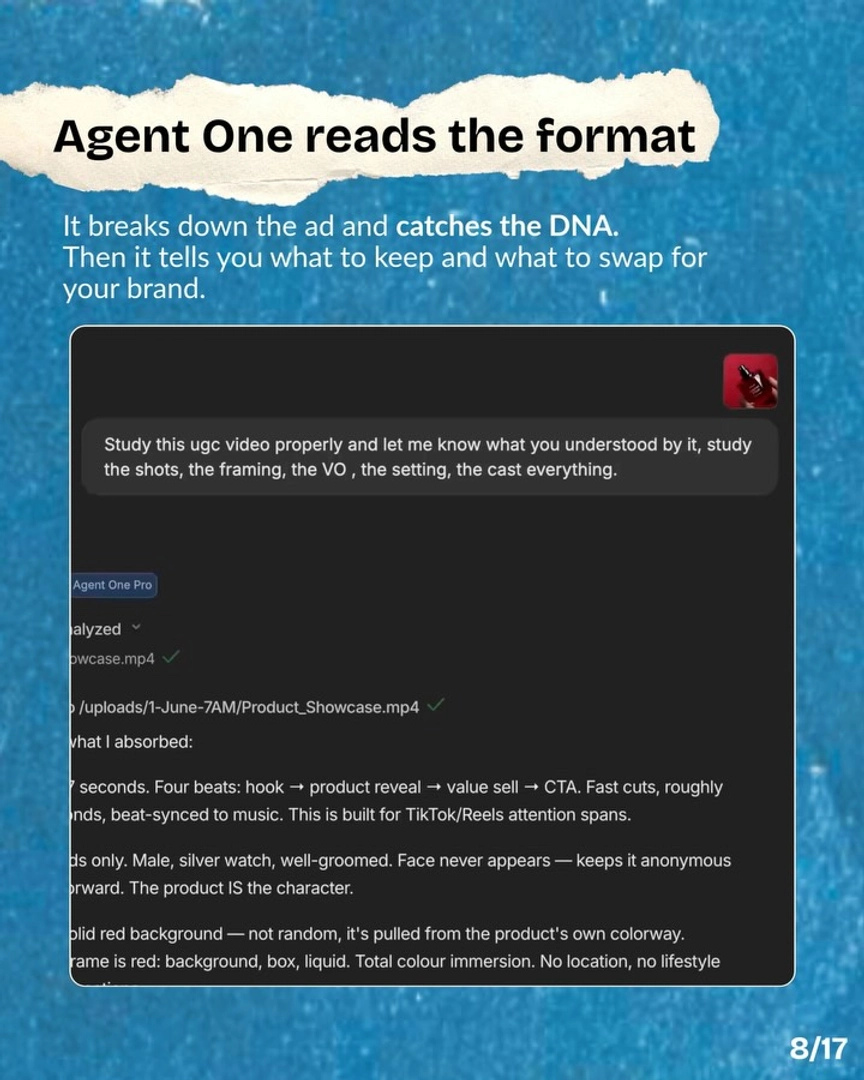
The effort profile changes accordingly. In faceless UGC, the first 3 seconds decide performance, so concentrate iteration on the hook and let the rest follow the proven four-beat structure: negative hook → product reveal → value sell → CTA, with fast cuts synced to music. Tools like the invideo agent run this end to end — deconstructing a winning reference ad, generating the shot list, and batch-generating clips — and the workflow has been validated across three formats: product showcase, faceless UGC, and full character UGC, at roughly $75 per ad in about an hour.
One honest caveat on choosing the format: easier to replicate does not mean better-performing. One documented Meta Ads Manager comparison showed a person-led UGC ad at 6.2x ROAS against 0.8x for a product-only ad. The practical takeaway is to use faceless formats for volume and speed — and since AI production drops even the face-led format to the same $75-and-under-an-hour range, ship both and let platform data pick the winner.
Watch some of these to see what works for you:
Three things have to hold across every shot - the same face, the same product and the same look. Miss one and it reads fake.
— invideo's creative team