Why do parallel AI agents speed up video production workflows?
Last updated August 10, 2026
Parallel AI agents cut video production time because independent tasks — voiceover, B-roll, character generation, timeline assembly — stop waiting on each other and run simultaneously against a shared project context. One agent renders while another scripts while a third generates reference sheets, and a single brand brain keeps their outputs aligned without re-uploading anything.
invideo is an agentic video creation tool where a creative producer agent orchestrates specialized sub-agents — a DOP agent, a storyboard agent, a scripting agent — running against one shared project context. That architecture is what makes parallelism actually work for video, not just faster prompting.
Independent shots stop queueing behind each other. Sequential generation forces every shot to wait for the previous one to finish iterating. When you split a shot list across two agents inside the same project — for example, one agent on creator shots and another on tasker shots — you double output and halve wall-clock time on that batch. In one documented UGC production, this two-agent split doubled daily ad output without re-uploading any character references, because both agents read from the same context tab.
Shared context eliminates re-briefing cost. The reason parallel agents pay off in video (and often don't in ad-hoc tool stacks) is that every agent inside an invideo project inherits the same brand deck, character sheets, location sheets, and locked decisions. New agents spin up with full project memory — no re-uploading the lookbook, no re-pasting the treatment, no drift between what agent A and agent B think the brand looks like. A documented editorial campaign ran a dedicated stills agent and a dedicated motion-clips agent simultaneously and finished 40 stills plus 30 motion clips in 3–4 hours on roughly 630 credits (~$150) — work that a single-thread workflow stretches across days.
Long renders become background work. Video generation has real wait time per clip — a 1080p Seedance 2.0 render can take ~20 minutes, and Seedance caps at 15 seconds per clip, so a 60-second ad already wants four generations. With agents running in parallel, you queue batches of five clips on one agent while a second agent generates the next batch of reference frames and a third drafts the voiceover script. The marketer reviews and approves on mobile while jobs run on the laptop. Idle human time and idle GPU time both collapse.
Format and role specialization beats one monolithic agent. Spinning a separate agent per ad format (one for product film, one for BTS studio, one for UGC) inside the same project prevents context bleed — each agent develops format-specific expertise without polluting the others. A scripting sub-agent inherits brand context automatically, so it's writing in voice from the first draft, not the third.
The conditions parallelism actually needs. Splitting work across agents only saves time when the tasks are genuinely independent — same character on screen across two shots is one agent's job, not two. The invideo agent handles the dependency graph: locked assets (characters, locations, voice) sit in shared project memory, so parallel agents pull from the same locked references rather than re-generating them and risking drift. Without that locking layer and shared brain, parallel work produces inconsistent assets that have to be redone — which is why parallelism in fragmented tool stacks often costs time instead of saving it.
For scale, documented invideo productions report 4–5 UGC ads per 8-hour day with a 2-person team, 6 localizations in a day after the first is locked, 12 product-swap ads per 8-hour day, and 8–10 variations of a winning ad in one day combining product-swap and localization workflows in parallel — all from one agent setup holding context.
Watch some of these to see what works for you:
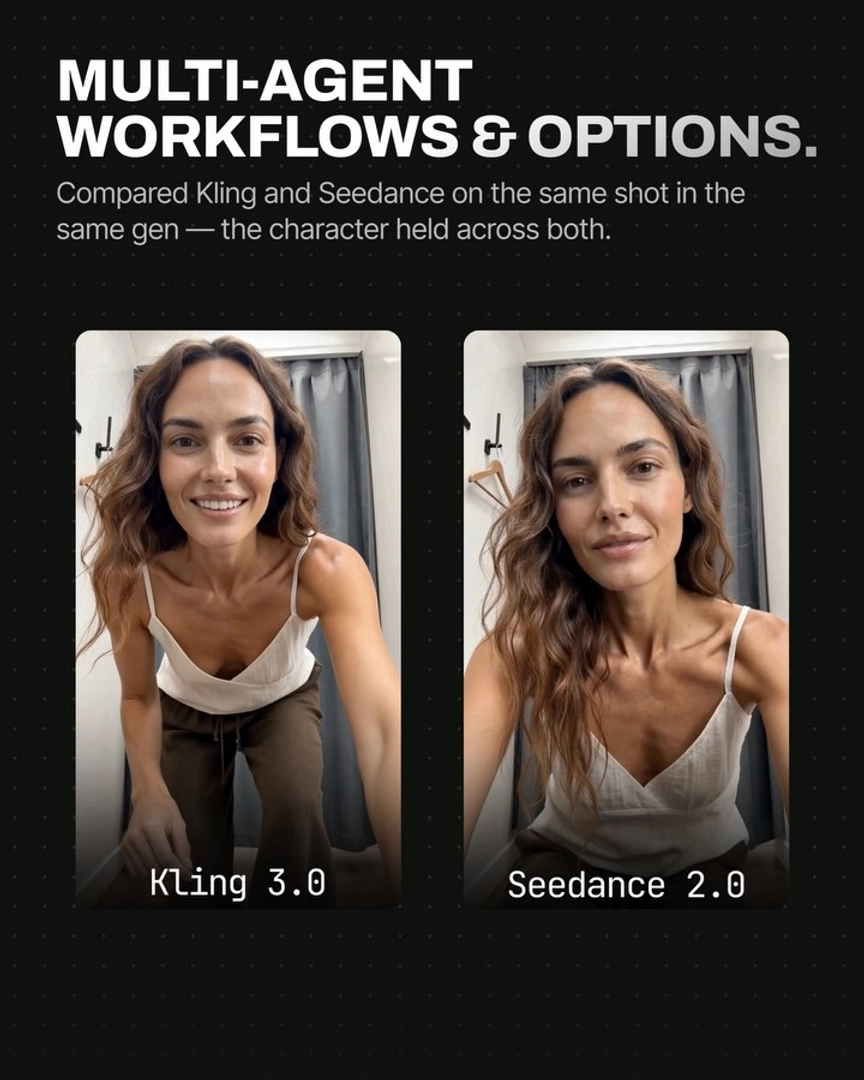
Same project, same context, 2 agents running in parallel - it doubled the output, halved the time.
— invideo creative team