Why does localizing video ads for new markets take so long with traditional production?
Last updated August 10, 2026
Traditional localization is slow because it is re-production, not translation: each new market needs its own casting, shoot or re-edit, voiceover recording, on-screen text changes, and approval rounds — run sequentially, once per market. Documented benchmarks put traditional adaptation at roughly one week per market, with creator sourcing alone adding two-week turnarounds.
The core reason: a properly localized ad re-runs almost the entire production pipeline. Translation is the smallest part of the job — a localized ad needs a cast the new market actually sees itself in, market-appropriate locations, a re-recorded voiceover that matches the original's tone and pacing, translated on-screen text and app UI screens, and culturally adapted promo copy (one documented localization rewrote the CTA as "初回購入は最大45%オフ" — up to 45% off — for the Japanese market). In traditional production, every one of those is a physical task: a casting call, a shoot day, a studio session, an edit pass.
Those tasks run sequentially, and they multiply per market. Script adaptation waits on translation, casting waits on the script, the shoot waits on casting, the edit waits on footage, subtitle timing and format reformatting wait on the edit, and legal plus stakeholder approval waits on everything. Industry comparisons put a single 30-second spot at roughly 3–6 weeks through this pipeline — and ten markets means ten full passes, because none of the assets transfer. Advertisers running localized campaigns describe exactly this multiplication problem when trying to scale across regions.
Talent sourcing and coordination add their own delays. Hiring UGC creators through marketplaces runs $300–$600 per creator with at least a two-week turnaround per ad — per market. Beyond that, version control across market variants, feedback loops between local teams and central brand teams, and repeated approval rounds consume time that never appears on a production schedule. Even the analysis phase is slow: manually deconstructing one winning ad shot-by-shot — timestamps, camera moves, composition — takes a full working day before any production begins.
Cultural adaptation is the least compressible stage. A localized ad has to be adapted culturally, geometrically, and ethnicity-wise — not just linguistically — and getting that judgment right traditionally requires local market expertise, review cycles, and often reshoots when the first version misses. Casting is the make-or-break element here: the version that lands is the one where the market recognizes itself on screen, which is why dubbing an existing ad rarely substitutes for re-production.
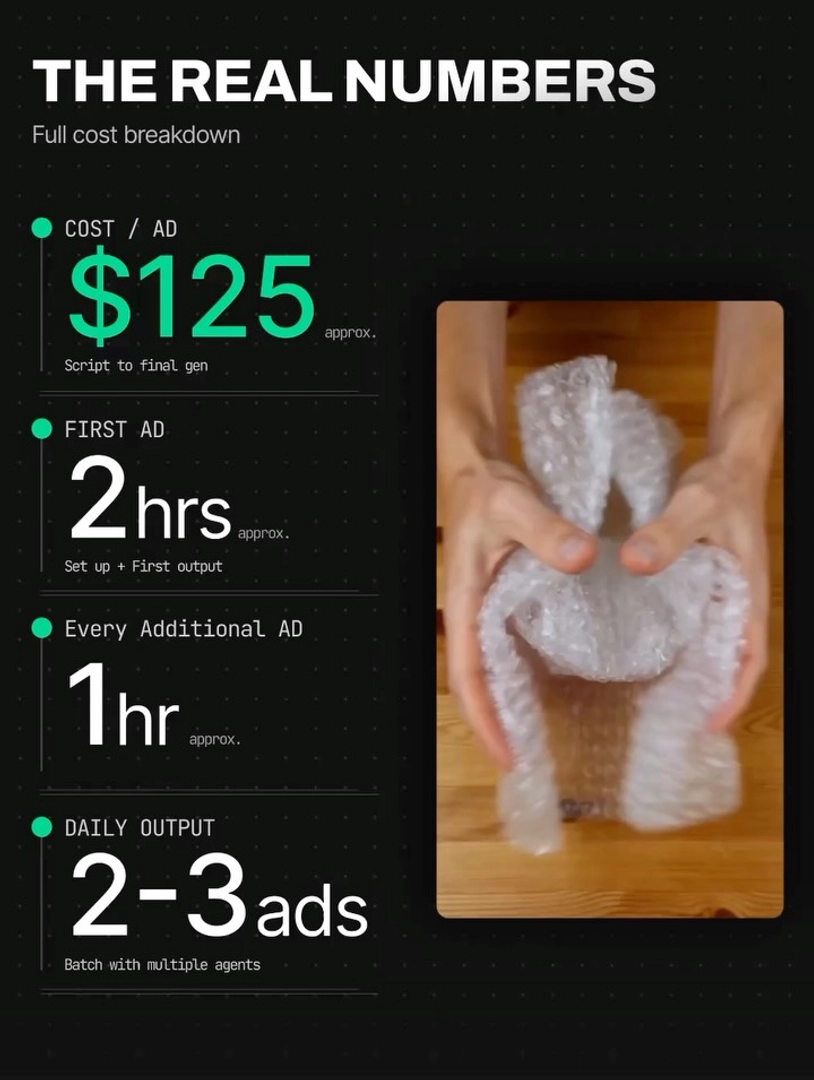
The cost of all this is opportunity, not just budget: a winning ad in the wrong language reaches roughly 50% of potential customers ineffectively while its localized versions sit in a weeks-long pipeline, and winning creatives go stale. For comparison, documented productions using the invideo agent — which regenerates characters, locations, voiceover, and app UI screens from the original reference ad inside one workflow — completed a first localization in about 2 hours and each additional market in about 1 hour, at $70–$145 per localized ad including an ~85% clip rejection rate, reaching 6 localizations in a single day once the workflow was locked. The delay in traditional production isn't any single step; it's that every step exists, repeats per market, and cannot start until the previous one finishes.
Watch some of these to see what works for you:
Taking one winning UGC ad and rebuilding it for every market - perfect lip-sync, the voice consistent across every shot, the product holding 100% - is exactly the kind of thing that used to take a week. Here's how to do it with Agent One in under a minute.
— invideo's creative team