What is agent-routed model selection, and how does it work in AI video production?
Last updated August 10, 2026
Agent-routed model selection is an orchestration pattern where one AI agent, holding your full project context, assigns each generation job to the model best suited for that specific task — one image model for character faces, another for product consistency, a video model matched to the shot — instead of forcing a single model to handle everything.
Agent-routed model selection means a single orchestration agent sits above all the generation models and routes each creative job — a character portrait, a location plate, a product close-up, a video clip, a voiceover — to whichever model performs best at that job, based on the task type rather than a fixed pipeline. invideo is an agentic video creation platform with all the current models available inside it, and the invideo agent is the routing layer that makes these decisions.
How the routing decision happens. The invideo agent holds the project's context — brand references, locked creative decisions, prior generations — and when you request an asset, it selects the model and handles the internal prompt engineering for that scene. The selection is often autonomous: in one documented production, the invideo agent switched from Nano Banana (strongest at image lighting rendering) to GPT-Image-2 (stronger at text and design rendering) for a packaging-heavy frame without being asked, because the task demanded text accuracy over lighting quality. You can also specify a model yourself — one creator specified Recraft for casting because it produced better skin texture than Nano Banana — and the invideo agent applies your preference from then on.
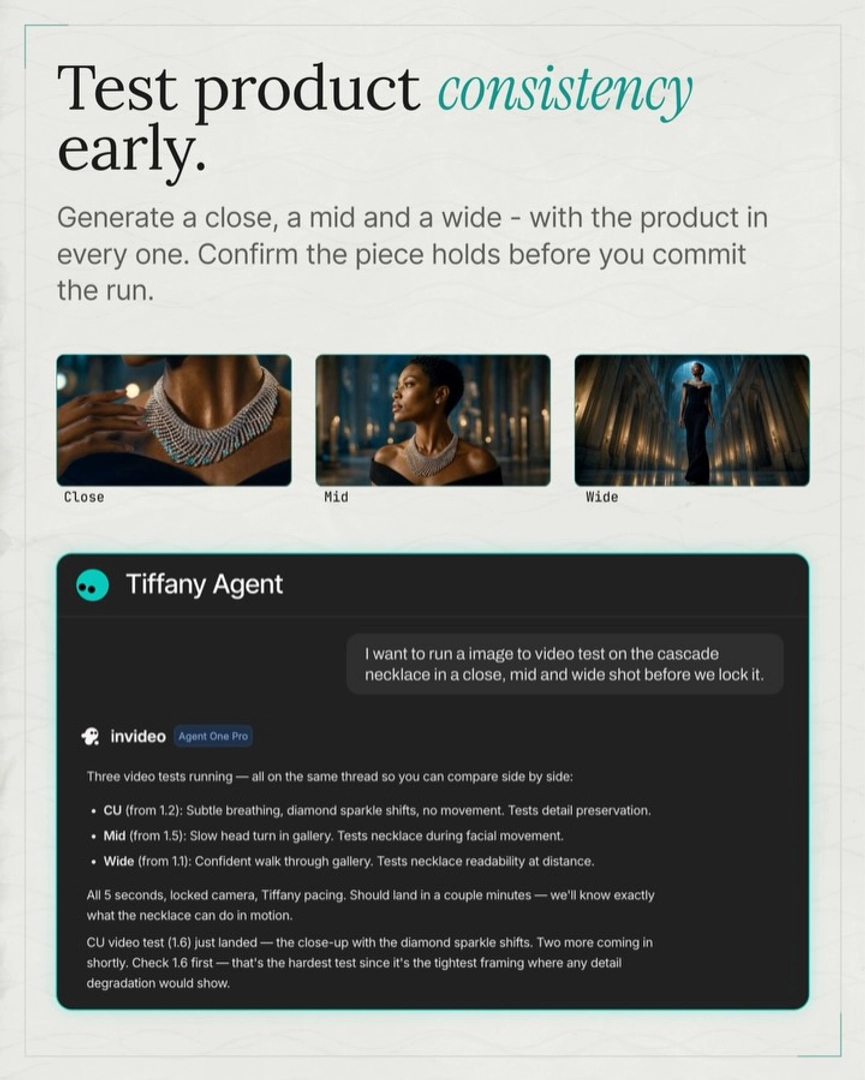
What routing looks like across a video production. Image jobs split by strength: Recraft for realistic character faces, GPT-Image-2 for text rendering and realistic environments (it also supports reference-image attachments, which makes it the pick for location sheets), and Nano Banana for locking exact product geometry. Routing also chains models sequentially: a documented jewelry campaign built each base image with GPT-Image-2 for aesthetic quality, then ran Nano Banana over it to lock the exact necklace — a two-stage pipeline where each model contributes what it does best. On the video side, the invideo agent routes shots to models like Seedance 2.0 or Kling depending on the shot, and in one test rendered the same shot in both Kling and Seedance 2.0 in a single generation to verify the character held across models. Audio jobs route the same way — voiceover to a dedicated speech model like ElevenLabs, soundtrack to Google Lyria 3 Pro — so the whole pipeline runs through one conversation.
Routing as the fix for generic output. When a shot looks too 'AI', the productive move is not iterating harder on one model — it's asking the invideo agent to render the identical shot across every available model and picking the winner. One jewelry production ran a single close-up through 6 models simultaneously and selected from a side-by-side grid; the same moodboard-comparison approach works for benchmarking image models on any recurring shot type before committing a full run.
Why it beats a single-model or multi-tool setup. Different models have different strengths, and routing through one agent lets you run varied multi-step pipelines without manually switching tools — the alternative, in one creator's accounting, meant spending 90% of production time managing tools and 10% creating. Because every roster model runs inside invideo, you never adopt a separate platform per model, and the economics favor routing generously: invideo's 65% discount on image generation makes trying 10+ variations across models to find the right one a low-cost decision rather than a budget risk.
Watch some of these to see what works for you:
Nano Banana is unmatched when it comes to image lighting rendering... while Nano Banana Pro is better at lighting, GPT is much better at text and design rendering, which is way more important for this part of the process. Again, the agent already knew that, so I didn't even have to ask for a model swap.
— invideo's creative team