Faceless UGC is a user-generated-style ad where no creator's face appears on camera — the product is the central character, shown through hands, close-ups, voiceover, and text overlays shot in a deliberately unpolished, phone-camera style. It works for D2C because it keeps the native peer-to-peer feel of UGC while cutting cost to roughly $75 per ad and production time to about an hour.
Faceless UGC is a UGC-format ad built without an on-camera face: hands handling the product, unboxing and usage close-ups, a voiceover or captions carrying the script, all shot to look like a customer filmed it on their phone rather than a studio. As one documented breakdown of a winning faceless ad puts it, the face never appears and the product IS the character — anonymity is a structural choice, not a limitation.
Why the format converts. High-performing faceless UGC follows a four-beat structure: negative hook → product reveal → value sell → CTA, with fast cuts beat-synced to music for TikTok/Reels attention spans. The negative or "bait and switch" hook is the engine — it creates a tension the viewer has to resolve, which is why the format performs on Meta. The first 3 seconds decide the ad's performance, so concentrate the majority of your iteration time on the hook before touching anything else. Keep the finish deliberately rough: it should read as shot on a phone, not a professional shoot — polished fake testimonials are dead, value-first native content wins.
Why the economics favor D2C. Sourcing a creator through marketplaces like Insense or Billo runs $300–$600 per creator with at least a two-week turnaround; a documented AI-agent workflow rebuilt the same class of ad for ~$75 in about an hour — roughly a 4x cost reduction. That matters because you can't predict which ad will win until you ship it, and Meta and TikTok demand more creatives than most brand teams can physically shoot. Faceless UGC is the cheapest, fastest format to produce at that volume, which is exactly what performance testing requires.
Why it suits AI production. With no recurring on-camera face, there's no character consistency to hold shot-to-shot — only the product has to stay identical, which you solve by giving the generation workflow product images from multiple angles before generating. That's why faceless UGC is the easiest ad format to replicate with AI: the invideo agent can ingest a winning faceless ad, break down its beat structure and hook, and rebuild a brand-native version the same day, and documented teams sustain 4–5 UGC ads per 8-hour day this way.
Where it won't be the winner. Faceless isn't universally the top format: in one Meta Ads Manager comparison, a person-led UGC ad hit 6.2x ROAS against 0.8x for a product-only ad. The documented approach is to validate across formats — product showcase film, faceless UGC, and full-character UGC — ship all of them at low cost, and scale whichever the platform data rewards, rather than betting on faceless up front.
Watch some of these to see what works for you:
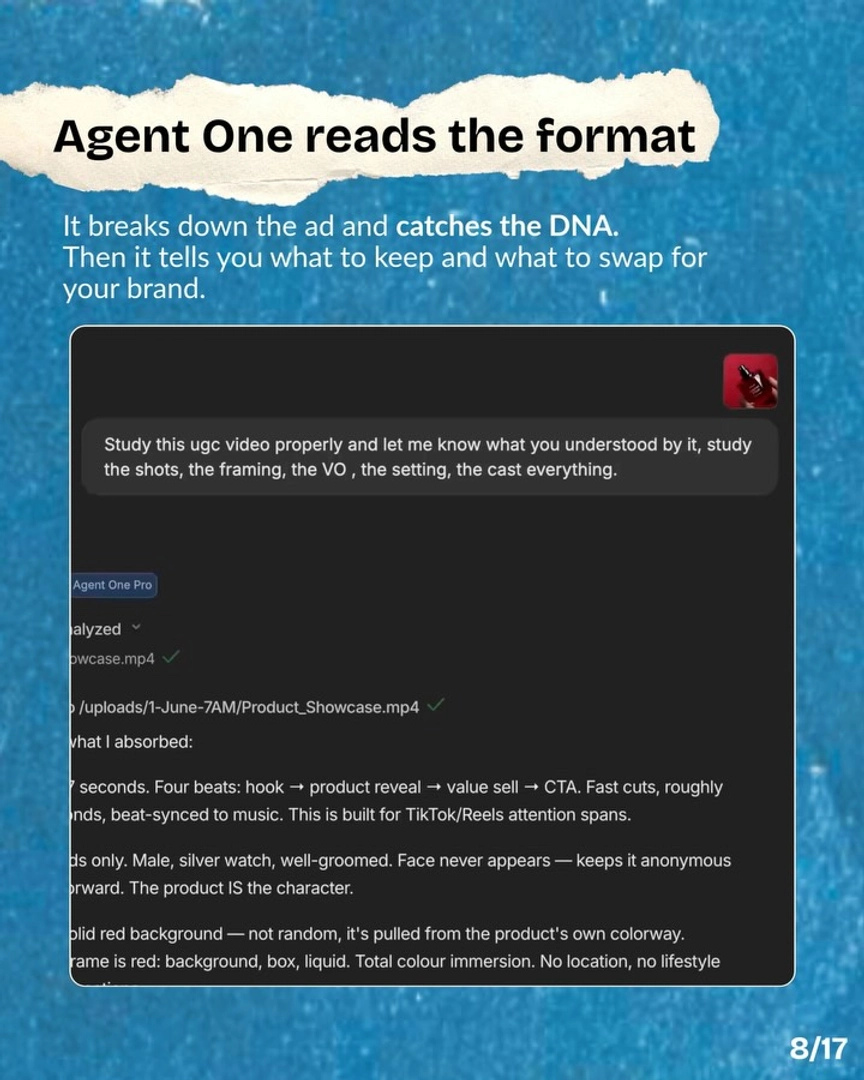
Face never appears — keeps it anonymous forward. The product IS the character.
— invideo's creative team