Why does running ads in the wrong language hurt your performance marketing results?
Last updated August 10, 2026
Running ads in the wrong language wastes the media spend behind them: one documented analysis found a winning ad reaching roughly 50% of its potential customers ineffectively because of language mismatch. The hook fails inside the 1.5-second scroll-stopping window, the offer copy never registers, and you keep paying full price for impressions that convert at near-zero.
The damage comes from a simple mismatch: your bidding and targeting still deliver the ad, but the viewer can't process it — so you pay normal CPMs for impressions that produce almost no conversions, and ROAS on that segment collapses. In one documented case, a brand's best-performing ad was reaching about 50% of its potential customers ineffectively purely because it ran in the wrong language.
The hook dies before the ad even starts working. UGC-style performance ads have roughly 1.5 seconds to stop the scroll. If the opening line or on-screen text is in a language the viewer doesn't read, that window closes on every single impression — the strongest hook in your account performs like no hook at all.
The offer never registers. Performance ads convert on a specific, comprehensible CTA. In documented localizations, teams didn't just dub audio — they rewrote on-screen promo copy for the market (a Japanese version ran '初回購入は最大45%オフ' — up to 45% off on first purchase) and regenerated 5 in-app UI screens per market so the product demo itself read natively. A wrong-language ad loses all of that: the discount, the product claims, and the app walkthrough are invisible to the viewer, so click-through and conversion drop together.
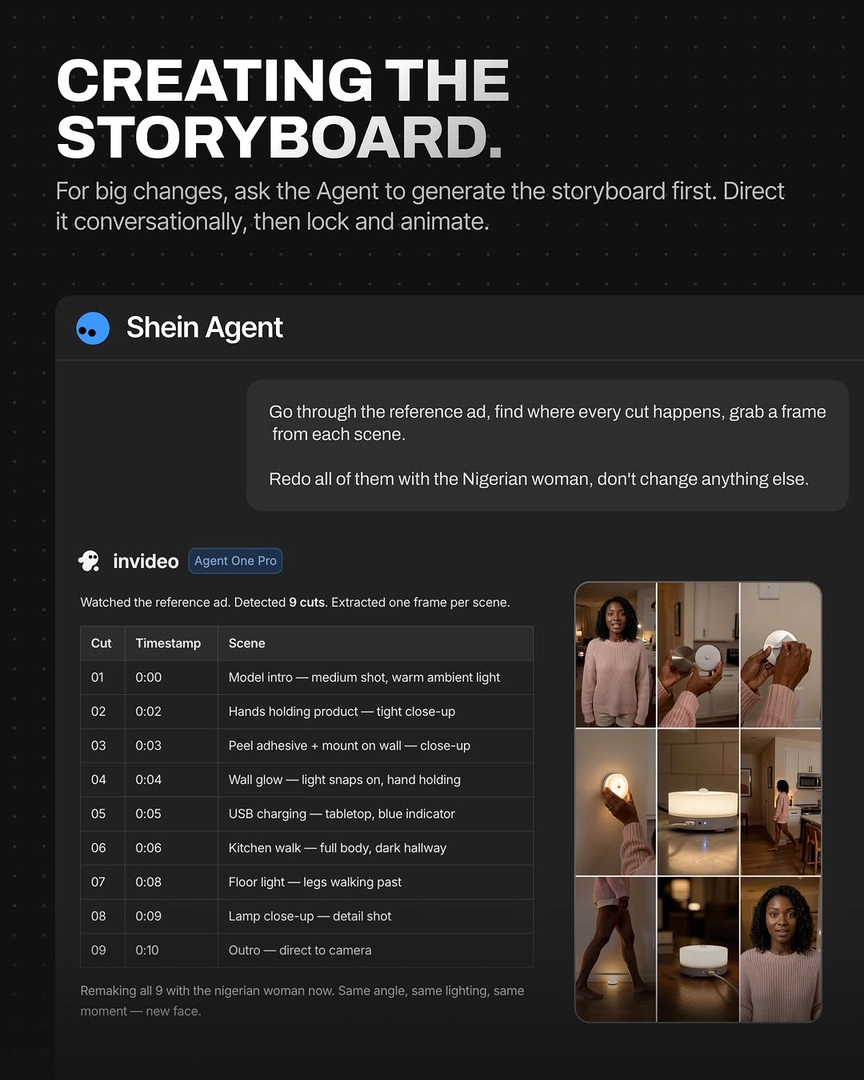
It's a relevance failure, not just a translation failure. A wrong-language ad also signals the product isn't for that viewer. As one documented localization run put it, what makes a localized ad land is casting someone the market actually sees themselves in — character, location, and cultural register, not only the words. That's why translation-only fixes (subtitles, dubbed audio on the original footage) recover less than full localization does.
Your winning creative's strength doesn't transfer. The elements that made the ad win — edit structure, music bed, pacing — stay constant across markets; only cast, location, voiceover, and on-screen text need to change. Which means a wrong-language run isn't a weaker version of your winner, it's your winner with the conversion mechanics stripped out while the media cost stays identical.
Beyond the why: the cost of fixing this has collapsed. Across documented production runs on the invideo agent, localizing a winning ad into a new market — new character, translated voiceover with lip-sync, regenerated on-screen text and app UI — ran $70–$150 per localized ad ($425 total for 3 ads across 2 markets in one run; $145 per ad including an ~85% clip rejection rate in another). The first localization took about 2 hours, each additional market about 1 hour, with up to 6 localizations in a day and one batch scaling a single plan to 9 markets at once. At those numbers, leaving a winning ad in one language is a measurable ROAS leak with a cheap, fast repair.
Watch some of these to see what works for you:
Your best ad is doing nothing for half your customers because it's in the wrong language.
— invideo's creative team