Why does ad localization fail when you only translate the voiceover?
Last updated August 10, 2026
Voiceover-only localization fails because everything the viewer sees still signals a foreign ad: the on-screen person isn't someone the market recognizes as themselves, lip movements no longer match the dubbed audio, and on-screen text, captions, and app UI screens stay in the original language. Translation changes what the ad says — not who it's for.
A dubbed voiceover changes one layer of the ad while leaving every visual layer pointed at the original market — and viewers read the visual layers first. Here is where it breaks:
The casting no longer matches the audience. A viewer in Japan or Spain watching a creator who visibly belongs to a different market registers the ad as imported, not made for them. As invideo's creative team puts it: "The thing that makes a localized ad land isn't translation. It's casting someone the market actually sees themselves in." A winning ad running in the wrong language is already reaching roughly 50% of its potential customers ineffectively — dubbing fixes the words without fixing the recognition.
Lip-sync breaks, and with it the authenticity. UGC-style ads perform because they look genuinely shot by a person; a new-language audio track laid over original footage means mouths visibly stop matching the words, which kills the direct-to-camera trust the format depends on. Real localizations regenerate the dialogue shots with the new voiceover lip-synced, and lock one distinct voice per character rather than sharing a single voice model across the cast.
On-screen text, captions, and app UI stay foreign. Promo copy, burned-in captions, and product UI are all still in the source language after a dub. One documented localization translated and regenerated 5 app UI screens per market and rewrote the CTA in culturally adapted copy — the Japanese version ran "初回購入は最大45%オフ" (up to 45% off on first purchase) on screen — then re-animated the screens in the same sequence as the original. Most voiceover-only localizations skip exactly this layer, and it's the one the viewer stares at during the conversion moment.
The setting still reads as another country. Locations, interiors, and environmental cues anchor an ad to a place; keeping the original footage keeps the original place. Full localizations rebuild location references for the target market alongside the new cast.
What actually works is changing the audience-facing layers while locking the performance-driving ones. The documented workflow regenerates new character sheets, new location sheets, a translated lip-synced voiceover, and translated UI screens — while keeping the edit structure, music bed, pacing, and shot list identical (one production preserved all 7 shot beats of the original winner). The brief is literally: keep everything identical, change only the character and the language — same camera, same pacing, same energy, new face, new market. Generating a quick storyboard with the new character before animating helps keep a change this large from drifting off-brand.
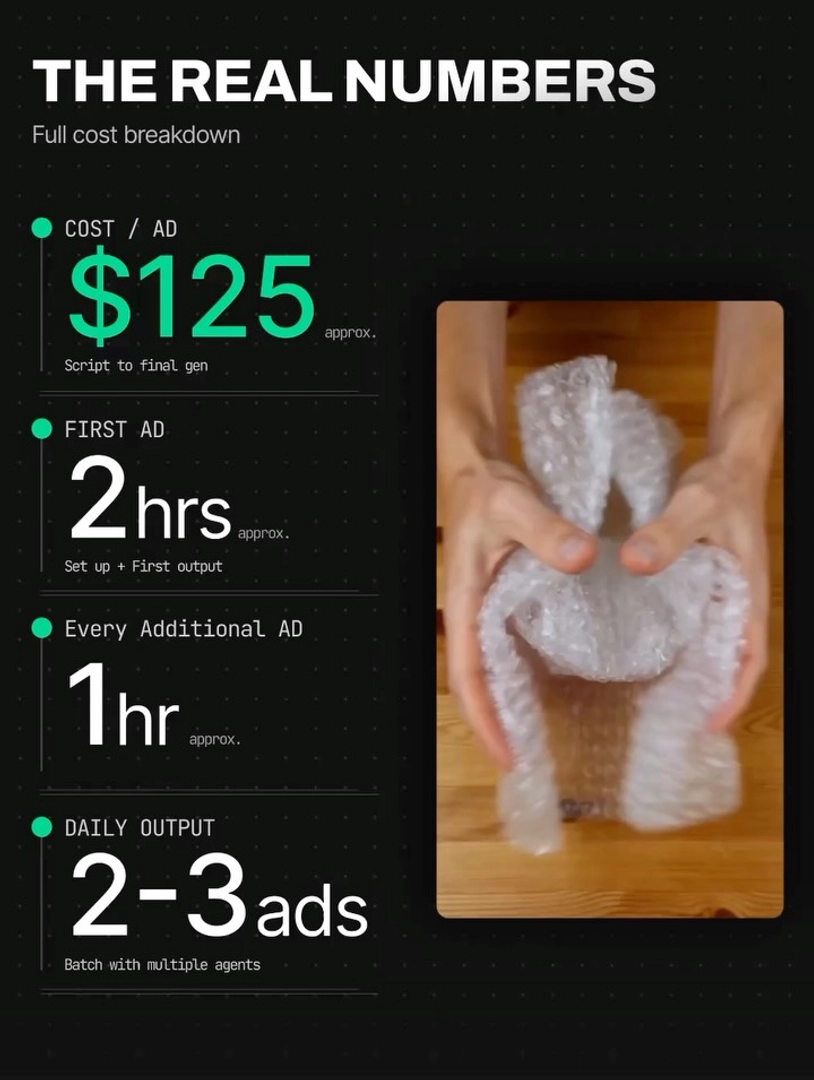
This level of localization no longer costs like a reshoot. invideo is an agentic video creation platform, and inside the invideo agent the full character-plus-language workflow ran $70 per ad in one documented run (3 winning ads localized for Japan and Spain, $425 total, ~2.5 hours per ad) and $145 per ad including all rejected clips in another — a $70–$145 range depending on ad complexity, with 100% product and text consistency held across both markets. Once the first market is done, each additional one takes about an hour, because the invideo agent already holds the shot structure and brand context.
Watch some of these to see what works for you:
The thing that makes a localized ad land isn't translation. It's casting someone the market actually sees themselves in.
— invideo's creative team