AI tools can parse a competitor ad's surface — copy patterns, cuts, pacing, composition — but they have zero access to the signals that explain conversion: click data, purchase events, audience match, and attribution, which all live inside the advertiser's ad account. Without that data and without your brand context, any 'why it converts' explanation is inference, not analysis.
AI tools can't explain why a competitor ad converts because the three inputs that explanation requires — the advertiser's conversion data, your brand context, and a validated link between creative choices and outcomes — are all missing from a generic model's view. As invideo's creative team puts it: "AI CAN'T read a winning ad. It doesn't know why it converted, or what matters to your brand, so it can't tell what to keep and what to change."
No access to conversion signals. Conversion happens in the advertiser's back end: click-through data, purchase events, audience targeting, attribution windows. None of that is visible in the ad file you upload. A model analyzing the video alone is analyzing the creative, not the performance — a survey of 200+ performance marketing teams found 73% have no visibility into why even their own winning ads win, and that data gap is total for a competitor's ad.
No brand context. Even a correct structural read is useless without knowing what applies to you. A generic tool can't distinguish the elements that drove performance (hook structure, pacing, emotional sequencing) from the elements that are brand-specific swaps (cast, product, setting, claims). That's the practical failure: it can't tell you what's safe to change, so unguided replication risks stripping out exactly what made the original work.
Causal inference from creative features is guesswork. Models weren't trained on ad creatives paired with their conversion outcomes, so when asked "why did this convert," they pattern-match to plausible-sounding marketing explanations — a known hallucination mode in competitive intelligence work. Treat any unverified causal claim from a raw model as a hypothesis, not a finding.
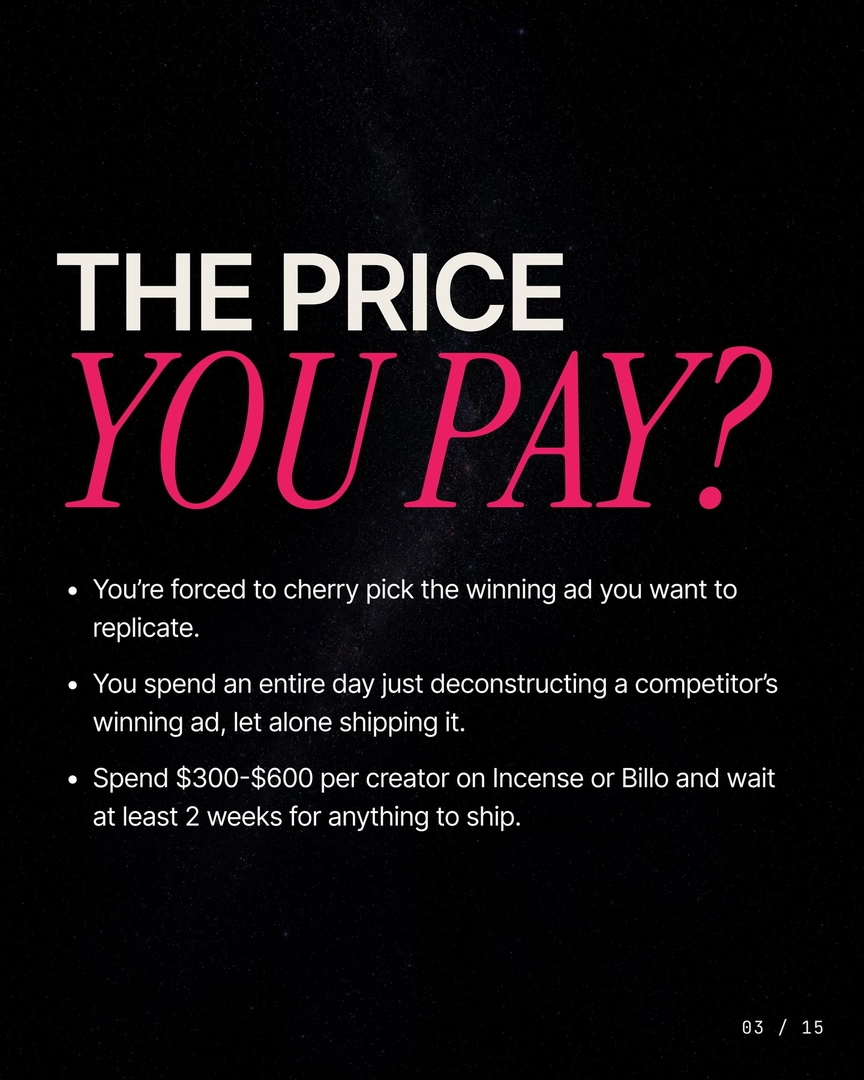
What actually works: structural deconstruction plus your own performance data. The structural half is solvable with an agentic workflow — invideo is an agentic video creation tool, and the invideo agent can ingest a reference ad and break it down shot by shot: in one documented run it detected all 9 cuts in a reference ad, extracted a frame per scene, and produced a timestamped breakdown of shots, framing, VO, pacing, and on-screen text, then flagged what to keep versus swap for the new brand. That replaces roughly a full day of manual deconstruction and feeds a rebuild costing about $75 in under an hour. The causal half comes from you: because per-creative cost is that low, ship multiple formats or hook variants simultaneously and let platform ROAS identify the driver — in one side-by-side, a person-led UGC version ran 6.2x ROAS against 0.8x for a product-only cut, a causal answer no analysis of the competitor's file could have produced. Structure from the agent, causality from your own tests — that's the honest division of labor.
Watch some of these to see what works for you:
AI CAN'T read a winning ad. It doesn't know why it converted, or what matters to your brand, so it can't tell what to keep and what to change.
— invideo's creative team