Why are performance marketers replacing their creative teams with AI agents?
Last updated August 10, 2026
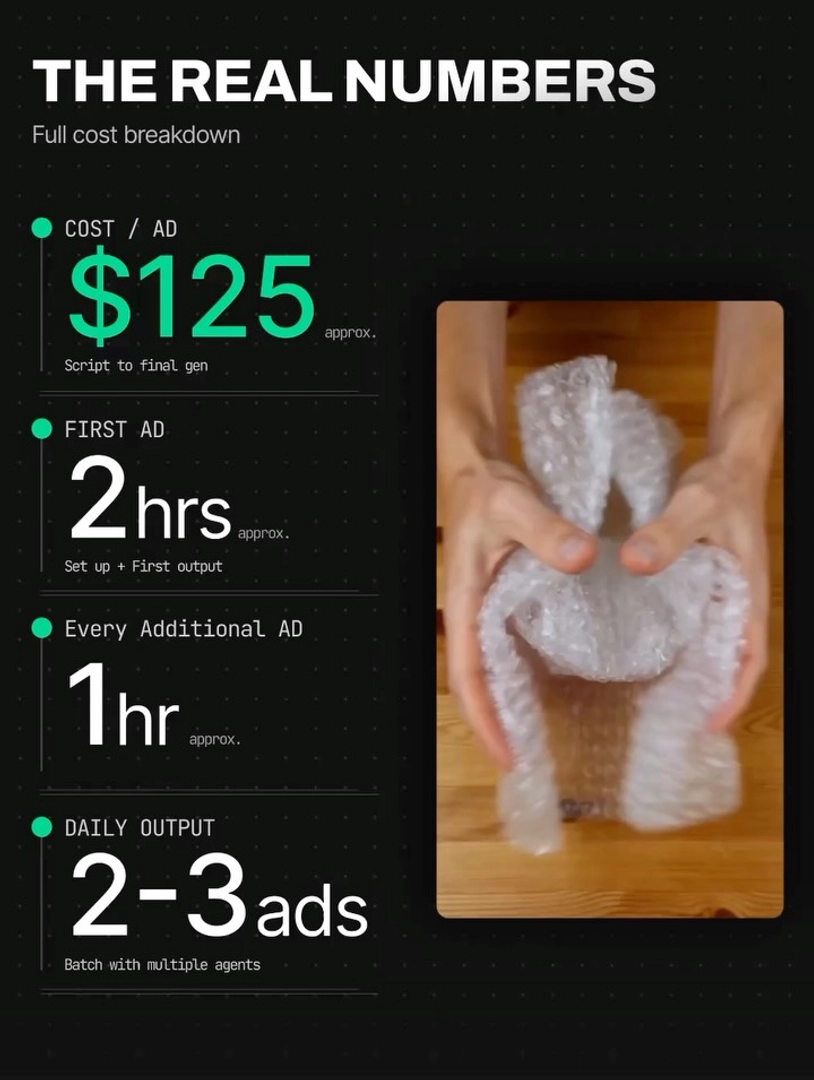
Performance marketers are replacing creative teams with AI agents because the work that used to need a full crew — scripting, casting, storyboarding, generation, voiceover, localization — now runs inside one agent project at roughly $70–$150 per ad and 2–3 hours each, with a single senior creative shipping 4–5 ads a day instead of one a week.
The shift is economic, not aesthetic. Performance marketing runs on volume — winning ads, product swaps, market localizations, weekly refreshes — and traditional teams cap out at one or two finished ads per creative per week. The invideo agent collapses that pipeline into a single project where briefing, casting, scripting, storyboarding, video generation, voiceover and music all happen in one conversation, with brand context loaded once and reused across every ad. invideo is an agentic video tool that holds all the current image and video models (Recraft, GPT-Image-2, Nano Banana, Kling, Veo, Seedance 2.0) and routes each shot to the right one, so the marketer doesn't pick tools per task.
1. The cost and throughput curve actually justifies the swap. Across documented production runs, UGC ads land at ~$125 per ad (500 credits) with a 2-person team producing 4–5 ads per 8-hour day. Localizations to a new market run ~$70–$145 per ad and ~2–2.5 hours each, after the first one is locked. Product swaps drop to ~$30 per ad and 30 minutes once the workflow is set, hitting 12 swap ads in an 8-hour day. A full multi-platform brand campaign came in at $33 / 155 credits versus a $100,000+ traditional equivalent. A three-ad jewelry campaign with 100% product consistency totaled ~$2,400. Range across documented productions: roughly $30–$150 per ad for swaps and localizations, $425–$1,300 per ad for higher-end brand films — all from one senior creative running the project.
2. One agent project replaces the multi-tool, multi-handoff stack. The old creative pipeline was a brief to a copywriter, a script to a director, a shoot day, an editor, a colorist, a VO session, a localization vendor. The new one is a sub-agent crew inside a single project: a creative producer agent absorbs the brand deck and website into context once (15–20 min one-time setup), a storyboard agent locks shots, a DOP agent routes generation across models, and a voice agent handles VO and lip-sync. Brands using two agents in parallel on the same project — one on creator shots, one on tasker shots — doubled output and halved time without re-uploading any shared context. As Hridaye, invideo's creative director, puts it: "Same project, same context, 2 agents running in parallel — it doubled the output, halved the time."
3. Scaling winners is the actual bottleneck — and agents solve it directly. The hard part of performance marketing isn't finding a winning ad; it's replicating it across products, characters, languages and regions without breaking what made it perform. Inside the invideo agent, that becomes a repeatable workflow: upload the winning ad, the agent detects every cut, extracts one frame per scene, generates new character and location sheets, translates the VO with matching tone and lip-sync, and regenerates only what changes. One documented run produced 6 fully localized UGC ads (3 ads × 2 markets) for $425 total. Another scaled the same plan across 9 markets in one batch by naming character reference files after their target language. Task that used to take a week now runs in under a minute of agent setup time.
4. The economics of iteration flip. Traditional creative is expensive to iterate — you don't reshoot to try a different hook. Agentic production assumes ~85% clip rejection as normal and prices it in. A documented production generated 108 images and 103 videos to use 49 final clips — and still came in at ~$125 per ad. invideo runs a 65% discount on image generation, so trying 10 variations of a frame is genuinely cheap, which lets the marketer test hooks, casts and CTAs at a volume a human team can't match.
5. The human role compresses upward, it doesn't disappear. One senior creative still runs the project — locking the brief, approving the storyboard, judging which clip wins, holding brand voice. What disappears is the production layer: the junior animators, the localization vendors, the per-project freelancer roll-up. The invideo agent pushed back on a 15-second duration request and recommended 20 seconds based on benchmark ad knowledge — agentic judgment, not just execution. That's the actual replacement pattern: the agent absorbs the production team, the human keeps the creative direction.
Beyond the comparison itself: full creative replacement is still rare for top-of-funnel brand work where craft and originality matter most. The dominant pattern is a senior creative directing an agent crew for the high-volume performance layer — UGC, localizations, product swaps, weekly refreshes — where speed and consistency beat bespoke craft.
Watch some of these to see what works for you:
It's serious brand teams treating an Agent as their creative team.
— Hridaye, invideo's creative director