Why should I start an AI video business now instead of waiting?
Last updated August 10, 2026
Start now because the economics already work and the advantage compounds: documented AI productions ran $750–$5,000 all-in ($315–$750 per finished minute) on 2–5 day timelines with 1–4 person teams, service models reach full-time revenue at 10 clients a month, and creators who start this week are projected to have three monetized channels within six months.
The case for starting now rests on three things you can verify: the production economics already work, the business models are already sellable, and the advantage compounds in a way a late entrant has to pay to catch up on.
The production economics already work. Documented productions ran $750–$5,000 all-in — a 70-second short for $750, a 3-minute animated episode for $950 ($315 per finished minute), a 2-minute brand promo for $1,500 — on 2–5 day timelines with teams of 1–4 people. That $1,500 promo compares against a traditional equivalent of $100,000–$500,000 and roughly 2 months of production, an up-to-99.7% cost reduction and ~20x time reduction. Across four productions with known length and cost, finished-minute cost ranged $315–$750 depending on team and approach — variance is natural, but every point in that range is a price a client will pay margin on top of. invideo is an agentic video creation tool with all the current video models (Veo, Kling, Seedance 2.0) available inside it, so you can start a service business today without assembling a tool stack — the invideo agent routes each shot to the right model for you.
The business models are sellable today, not someday. Three documented models: a done-for-you YouTube service — four cinematic videos a month with zero cameras and zero editing, sold to coaches, lawyers, dentists, and local businesses, where 10 clients a month equals a full-time business and 99% of businesses told they need YouTube never start, so the demand is unserved; course production, compressed from 3–6 months to 14 days, with courses priced $297–$997 and some creators charging $3,000–$5,000; and multi-channel faceless YouTube, viable because editing — roughly 95% of total content production time — is exactly what the agentic workflow absorbs. For client acquisition, sell the outcome ('their own YouTube channel'), not the technology; referrals are the highest-leverage channel and local Facebook groups are underutilized for finding done-for-you clients.
The advantage compounds, so waiting has a price. Each session with the invideo agent progressively trains it on your style, making every subsequent project faster — your workflow becomes an asset a new entrant doesn't have. YouTube monetization (1,000 subscribers, 4,000 watch hours) is a volume game, and production speed directly increases the probability of hitting it. The documented projection: six months of consistent output yields three monetized channels. As one creator put it, the people who wait face more competition for the same clients and audience — the second mover pays a catch-up premium in both trust and reach that the first mover banked for free.
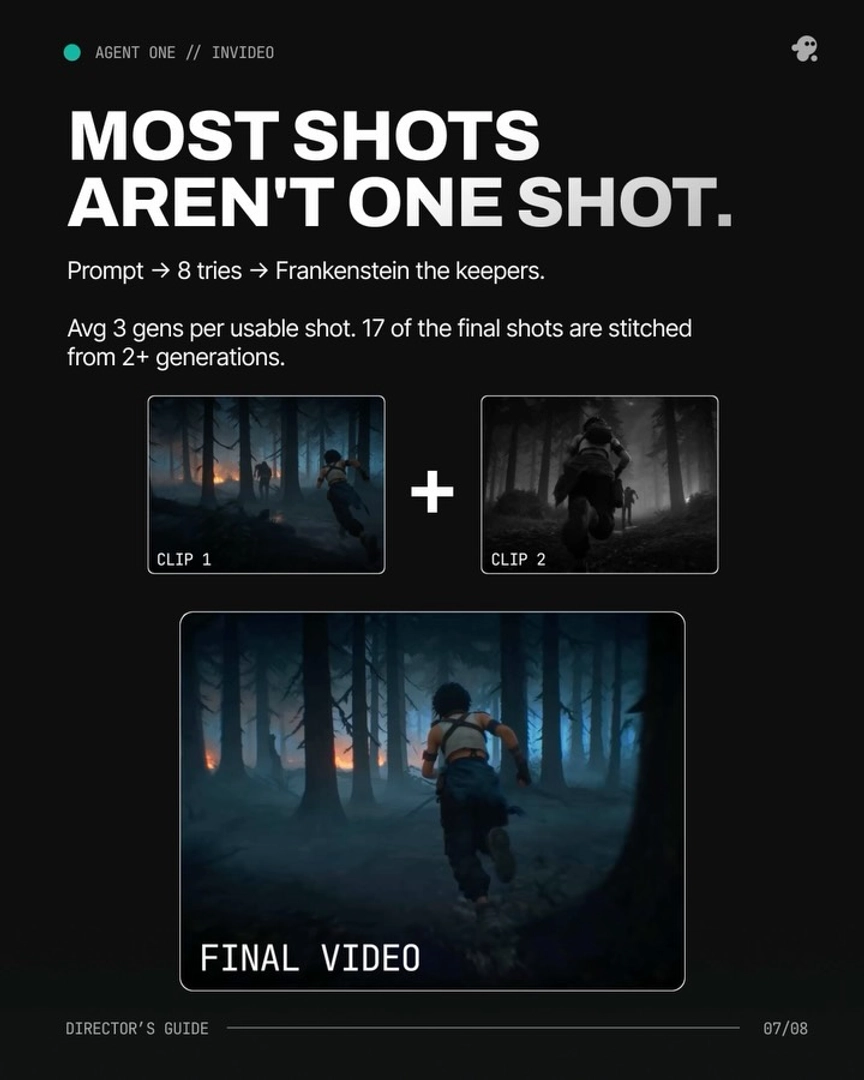
Budget honestly for iteration. Starting now doesn't mean the output is free of rework: one documented episode used 41 of 164 generated clips (a ~25% selection rate), and overgeneration is a deliberate budget line, not waste — all the cost figures above already include it. Price your services with that iteration margin built in and the numbers still clear comfortably against what clients pay for traditional production.
Watch some of these to see what works for you:
Six months from now, the people who started this week will have three monetized channels. The ones who waited will be facing more competition.
— a creator documenting AI video business models built on the invideo agent